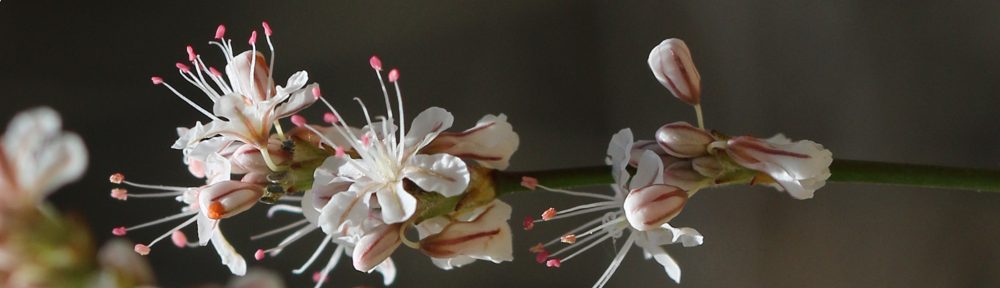
Plants subshrubs or shrubs, 2–6 (8) dm tall, 3–8 (12) dm across; leaves cauline 1⁄2 or more length of flowering stem, the petioles 0.5–0.8 cm long, the blades usually elliptic, 2–4 cm long, 1–1.5 cm wide, densely tomentose abaxially, usually glabrous and green adaxially; inflorescences 3–10 cm long, the branches glabrous or nearly so; involucres 1–2 mm long, 1–1.5 (2) mm wide; flowers 1.5–2.5 mm long, the perianth yellow to pale yellow, rarely nearly white, glabrous. Continue reading
Author Archives: xochipelli2012
Eriogonum heermannii var. sulcatum
Plants subshrubs, spreading, densely branched, (0.5) 1–8 dm tall, 2–8 dm across; leaf blades linear-lanceolate to elliptic or spatulate, 0.4–1.2 (1.5) cm long, 0.2–0.8 cm wide, thinly tomentose abaxially; inflorescences 1–5 (8) cm long, 3–10 cm wide, the branches diffuse, with dichotomously arranged involucres, slender, sharply ridged and deeply grooved, minutely scabrellous, not spinose; involucres campanulate, 0.7–1.5 (2) mm long and wide; flowers 1.5–2.5 mm long, the perianth yellowish-white, the tepals glabrous. Continue reading
Eriogonum deflexum var. baratum
Plants 3–10 dm tall; flowering stems fistulose; leaves basal, the petioles 1–7 cm long, usually floccose,the blades cordate to reniform or nearly orbiculate, 1–2.5 (4) cm long, 2–4 (5) cm wide, densely white- tomentose abaxially, less so to floccose or subglabrous and grayish to greenish adaxially, the margins entire; inflorescences cymose, open to diffuse, flat-topped, spreading, hemispheric or narrowly erect and strict with whiplike branches, 10–90 (180) cm long, 5–50 cm wide, the branches glabrous, occasionally glaucous, the bracts 3, scalelike, 1–3 mm long, 0.5–1.5 mm wide;peduncles deflexed, (0.3) 0.5–1.5 cm long; involucres narrowly turbinate to turbinate, 1.5–2.5 (3) mm long, 1–2.5 mm wide, glabrous, the teeth 5, erect, (0.2) 0.5–1 mm long; flowers 2–2.5 mm long, the perianth white to pink, with greenish to reddish midribs, becoming pinkish to reddish, glabrous, the tepals dimorphic, the outer tepals cordate, the stamens included, 1–1.5 mm long, the filaments glabrous or sparsely pilose proximally; achenes brown to dark brown, trigonous, (1.5) 2–3 mm long, glabrous. 2n = 40.
Eriogonum racemosum
Plants herbs, erect to slightly spreading, 3–8 (10) dm tall, 0.5–1.5 dm across, tomentose to floccose or rarely glabrous, grayish; stems spreading to erect, without persistent leaf bases, up to 1/6 height of plant, the caudex stems absent, the aerial flowering stems erect to slightly spreading, slender to stout, solid, not fistulose, (1) 1.5–2.5 (3) dm long, tomentose to floccose, rarely glabrous; leaves basal, 1 per node, the petioles (2) 3–10 (15) cm long, tomentose to floccose, the blades elliptic to ovate or oval to nearly rotund, (1.5) 2–6 (10) cm long, 1– 4 (5) cm wide, lanate to thinly tomentose abaxially, floccose or glabrous and green adaxially, the margins plane; inflorescences virgate or racemose with involucres racemosely disposed throughout or at tips, 15–50 cm long, 05–20 cm wide, tomentose, rarely glabrous, the branches dichotomous, upper secondaries suppressed and bearing 5–20 (30) racemosely arranged involucres, the bracts 3, scalelike, triangular, and (1) 2.5–7 mm long, or foliaceous, linear-oblanceolate or oblanceolate to elliptic, and 10–40 mm long, 5–20 (25) mm wide; peduncles absent or erect, stout, 0.3–4 cm long, tomentose to floccose; involucres 1 per node, turbinate to turbinate-campanulate, (2) 3–5 mm long, (2) 2.5–4 mm wide, tomentose to floccose, the teeth 5, erect, (0.1) 0.2–0.5 mm long; flowers (2) 2.5–5 mm long, the perianth white to pinkish, glabrous, the hypanthium 1⁄4 length of perianth, the tepals monomorphic, oblong, the stamens exserted, 2–5 mm long, the filaments pilose proximally; achenes light brown, 3–4 mm long, glabrous. 2n = 36. Continue reading
Eriogonum lonchophyllum var. lonchophyllum
Plants shrubs, subshrubs, or herbs, spreading to erect, not scapose, (1) 1.5–5 dm tall, 2–5 (8) dm across, glabrous or rarely floccose to tomentose, green to grayish; stems spreading or erect, usually without persistent leaf bases, up to 1⁄2 or more height of plant, the caudex stems absent or matted to spreading, the aerial flowering stems spreading to erect, slender, solid, not fistulose, 0.3–3 dm long, glabrous or, rarely, floccose to tomentose, tomentose among leaves; leaves basal or cauline on proximal 1⁄2 of stem, 1 per node, the petioles 0.5–2 cm long, tomentose to floccose or glabrous, the blades narrowly lanceolate or oblanceolate to elliptic, 1.5–7 (9) cm long, 0.2–2 cm wide, velvety- to densely white-tomentose abaxially, sparsely tomentose to thinly floccose or glabrous and green adaxially, the margins plane or occasionally crenulate, inflorescences cymose, dense to more commonly open, 2–25 cm long, 2–20 cm wide, the branches dichotomous, glabrous or, rarely, floccose, the bracts 3, scalelike, usually triangular, and 1–3 mm long, or occasionally leaflike, 8–30 mm long, and otherwise similar to leaf blades; peduncles absent or erect, 0.1–0.8 cm long, glabrous; involucres 1 per node or 2–5 per cluster, turbinate to turbinate-campanulate, 2.5–4 mm long, (1.3) 1.5–3.5 (4) mm wide, glabrous, the teeth 5, erect, 0.4–0.9 mm long; flowers 2–3.5 (4) mm long, the perianth white, glabrous, the hypanthium 1⁄4-1⁄3 length of perianth, the tepals monomorphic, oblanceolate, elliptic to oblong or obovate, the stamens exserted, 2–4 mm long, the filaments pilose proximally; achenes light brown to brown, 2–3 mm long, glabrous except (typically) for slightly papillate beaks.
Eriogonum lonchophyllum var. nudicaule
Plants shrubs, subshrubs, or herbs, spreading to erect, not scapose, (1) 1.5–5 dm tall, 2–5 (8) dm across, glabrous or rarely floccose to tomentose, green to grayish; stems spreading or erect, usually without persistent leaf bases, up to 1⁄2 or more height of plant, the caudex stems absent or matted to spreading, the aerial flowering stems spreading to erect, slender, solid, not fistulose, 0.3–3 dm long, glabrous or, rarely, floccose to tomentose, tomentose among leaves; leaves basal or cauline on proximal 1⁄2 of stem, 1 per node, the petioles 0.5–2 cm long, tomentose to floccose or glabrous, the blades narrowly lanceolate or oblanceolate to elliptic, 1.5–7 (9) cm long, 0.2–2 cm wide, velvety- to densely white-tomentose abaxially, sparsely tomentose to thinly floccose or glabrous and green adaxially, the margins plane or occasionally crenulate, inflorescences cymose, dense to more commonly open, 2–25 cm long, 2–20 cm wide, the branches dichotomous, glabrous or, rarely, floccose, the bracts 3, scalelike, usually triangular, and 1–3 mm long, or occasionally leaflike, 8–30 mm long, and otherwise similar to leaf blades; peduncles absent or erect, 0.1–0.8 cm long, glabrous; involucres 1 per node or 2–5 per cluster, turbinate to turbinate-campanulate, 2.5–4 mm long, (1.3) 1.5–3.5 (4) mm wide, glabrous, the teeth 5, erect, 0.4–0.9 mm long; flowers 2–3.5 (4) mm long, the perianth white, glabrous, the hypanthium 1⁄4-1⁄3 length of perianth, the tepals monomorphic, oblanceolate, elliptic to oblong or obovate, the stamens exserted, 2–4 mm long, the filaments pilose proximally; achenes light brown to brown, 2–3 mm long, glabrous except (typically) for slightly papillate beaks. Continue reading
Eriogonum abertianum
Ethnobotany. According to the book “The Ethnobotany of the Ramah Navaho” (Vestal, Paul A., 1952, Papers of the Peabody Museum of American Archaeology and Ethnology), Eriogonum abertianum was used – in decoction – as a lotion for skin cuts of horses and human beings.
Diversity. Jim Reveal did not describe the different varieties of this species. Nonetheless, Raymond Fosberg in “Eriogonum and its varieties” (published in “Madroño” in 1938) described them and the descriptions are posted below the following pictures.
Recent researches. In the Journal of Ecology (September 1993), un article titled “Annual Seed Dormancy Cycles in Two Desert Winter Annuals” describes the annual cycles of dormancy in the seeds of Eriogonum abertianum.
Selon Baskin et al (1993), “Nondormant seeds of the desert winter annual Eriogonum abertianum germinated to 86 and 79% in light at 15/6 and 20/10° C, respectively, but to only 3, I, and 0% at 25/ 15, 30/15, and 35/20 ° C, respectively.”
In Oecologia (1997), l’article “Interactions between winter and summer annuals in the Chihuahan Desert”, Guo and Brown cites Kemp 1983 and Inouye 1991: “The three biseasonal species (Eriogonum abertianum, Haplopappus gracilis, and Baileya multiradiata), germinated in fall and winter, but unlike the winter annuals, individuals survived through the spring droughts (Fig. 1). Although mortality during this period was often severe (sometimes >95%) and the surviving rosettes lost their outer leaves, the surviving plants grew rapidly in response to the first summer rains. In years when mortality during the spring drought was relatively low, the surviving plants, because of their size advantage and well established root system, were often able to dominate the summer annual plant community in terms of both individual plant size and total species biomass”.
Description from Jim Reveal’s Manual. Plants herbs, erect or spreading, annual, 0.5–6 (7) dm tall, hirsute, greenish, grayish, tawny, or reddish; stems with caudex absent, the aerial flowering stems prostrate to erect, solid, not fistulose, 0.1–1 dm long, appressed- hirsute; leaves basal and cauline; basal: petiole 0.5–6 cm long, villous to hoary, blade oblong to obovate, 1–4 cm long, 1–3 cm wide, villous to hoary-tomentose and greenish, tawny, or reddish on both surfaces, the margins plane, occasionally crenulate; cauline: sessile, blade linear, lanceolate, or narrowly obovate, 1–4 cm long, 0.3–2 cm wide, similar to basal blade; inflorescences cymose, open to diffuse, 5–40 (60) cm long, 5–50 cm wide, the branches hirsute, the bracts 3–6, semi-foliaceous, 2–10 mm long, 1–3 mm wide; peduncles ascending to erect, mostly straight, slender, 0.5–6 cm long, villous to hoary-tomentose; involucres broadly campanulate, 2–3 mm long and wide, villous-canescent, the teeth 5, lobelike, usually reflexed, 4–6 mm long; flowers 3–4.5 mm long, the perianth white to pale yellow in early anthesis, becoming reddish or rose, glabrous, the tepals dimorphic, those of outer whorl orbiculate-cordate, those of inner whorl lanceolate to spatulate, the stamens mostly exserted, 1.5–3.5 mm long, the filaments mostly pilose proximally; achenes brown to dark brown, lenticular, 0.6–1 mm long, glabrous. 2n = 40.
Eriogonum leptophyllum var. leptophyllum
Plants mostly (2) 4–8 (13) dm tall and tall, round to spreading shrubs not scapose, thinly pubescent or glabrous and green, yellowish-green or infrequently grayish, occasionally papillate; stems spreading or prostrate, without persistent leaf bases, up to 1⁄3 height of plant when shrubby, the caudex stems absent or compact, the aerial flowering stems spreading or prostrate, slender, solid, not fistulose, (0.05) 0.1–0.8 dm long, thinly pubescent or glabrous; leaves cauline, 1 per node or fasciculate, the petioles 0.05–0.1 cm long, tomentose to floccose or glabrous, the blades linear to linear-oblanceolate, (0.5) 2–6 cm long, (0.03) 0.1–0.3 cm wide, densely to thinly white-tomentose abaxially, thinly so or glabrous and green adaxially, the margins tightly revolute; inflorescences cymose, usually compact, (0.1) 2–12 (15) cm long, (1) 4–15 (30) cm wide, the branches dichotomous, thinly pubescent or glabrous, the bracts 3, scalelike, triangular, (0.5) 1–4 mm long; peduncles absent or erect, 0.05–0.2 cm long, glabrous; involucres 1 per node, narrowly turbinate, 2–4 (4.5) mm long, 1–2 mm wide, glabrous, the teeth 5, erect, 0.3–0.7 mm long; flowers 2.5–4 mm long, the perianth white, glabrous, the hypanthium 1⁄4 length of perianth, essentially monomorphic, oblong to narrowly obovate, the stamens long-exserted, (2) 3–6 mm long, the filaments subglabrous or sparsely puberulent proximally; achenes brown, (2.5) 3.5–4 mm long, glabrous. 2n = 40.
Eriogonum divaricatum
On September 6th 2014, I was chasing the Buckwheats around the Meteor Crater Center and taking a plethora of early pictures starting at 7 AM. Then, while I was shooting images (and there was strictly no visitors in the center), I got chased 3 times by the staff of the place; the last time being at 8H10 AM, when I was taking difficult pictures of Eriogonum divaricatum – difficult because the flowers are very dispersed and because of the same color background. Thus, I got chased the third time, 2 kms away from the center, because I was taking pictures of a pretty rare and discrete species of Wild Buckwheats, a few meters from the road, supposedly on a private land – a desert place with no fence and no animals (35°2’30” / N 111°2’3″ W). What is going on?
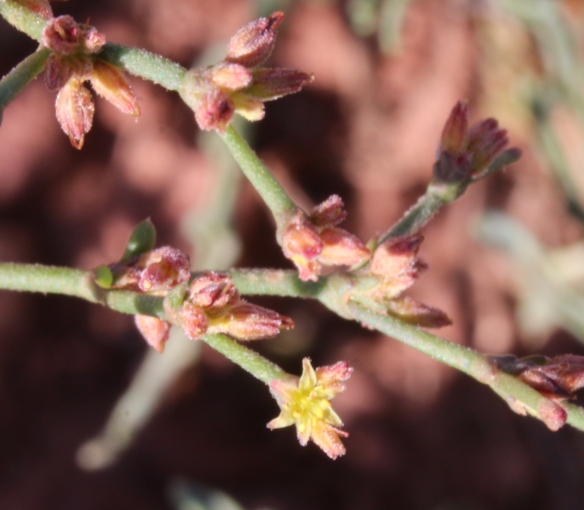
Plants herbs, spreading, 1–2 (3) dm tall, puberulent to short-pilose, greenish to reddish; aerial flowering stems decumbent to spreading, 0.3–0.5 dm long, puberulent to short-pilose; leaves basal and cauline, the basal ones with petioles 1–4 (5) cm long, puberulent to short-pilose, the blades elliptic-oblong to orbiculate, 1–2 (2.5) cm long and wide, puberulent to short-pilose and green on both surfaces, the cauline ones with petioles (0) 0.1–2cm long, puberulent to short-pilose, absent distally, the blades opposite, oblanceolate to oblong or elliptic, 0.3– 1 (1.5) cm long, 0.2–0.8 (1.2) cm wide, similar to basal blade; inflorescences cymose, distally uniparous due to suppression of secondary branches, diffuse, 5–25 cm long, 10–45 cm wide, the branches puberulent, the bracts 1–3 (5) mm long, 1–2 mm wide; peduncles absent; involucres somewhat appressed to branches, campanulate, 1–2 mm long and wide, pilose, the teeth 5, lobelike, spreading to somewhat reflexed, 0.7–1.5 mm long; flowers (1) 1.5–2 mm long, the perianth yellow, rarely pale yellow, hispidulous and glandular with yellowish-white hairs, the tepals monomorphic, oblong-lanceolate to oblong-ovate, the stamens included, 0.7– 1.5 mm long, the filaments pilose proximally; achenes light brown, trigonous, 1.5–2 mm long.
Eriogonum jonesii
Plants subshrubs, spreading, not scapose, 2–5 dm tall, 2.5–5 (6) dm across, white- to brownish-tomentose, reddish- to brownish-white; stems spreading, without persistent leaf bases, up to 1⁄4 height of plant, the caudex stems absent, the aerial flowering stems erect or nearly so, somewhat stout, solid, not fistulose, 1–2 (2.5) dm long, floccose; leaves cauline on proximal 1–7 (9) cm of stem, 1 per node, the petioles 1.5–4 (5) cm long, tomentose, the blades cordate, (1.5) 2–3.5 cm long, 1–2 (2.5) cm wide, densely white-tomentose abaxially, floccose and greenish or brownish white adaxially, the margins plane or crenulate; inflorescences cymose, usually open, 3–15 cm long, 5–20 cm wide, the branches dichotomous, tomentose to floccose, the bracts 3, scalelike, triangular, 1–4 mm long; peduncles absent; involucres 1 per node, turbinate, 1.5–2 (2.5) mm long, 1–1.5 (1.8) mm wide, the teeth 5–6, erect, 0.3–0.5 mm long; flowers 2–3 mm long, the perianth brownish- white, glabrous, the hypanthium 1⁄4 length of perianth, the tepals dimorphic, those of outer whorl obovate, 1.8– 2 mm wide, those of inner whorl lanceolate to narrowly elliptic, 1–1.2 mm wide, the stamens slightly exserted, 2.5–4 mm long, the filaments glabrous or sparsely pilose proximally; achenes brown, 2–2.5 mm long, glabrous.
 Eriogoneae
You must be logged in to post a comment.