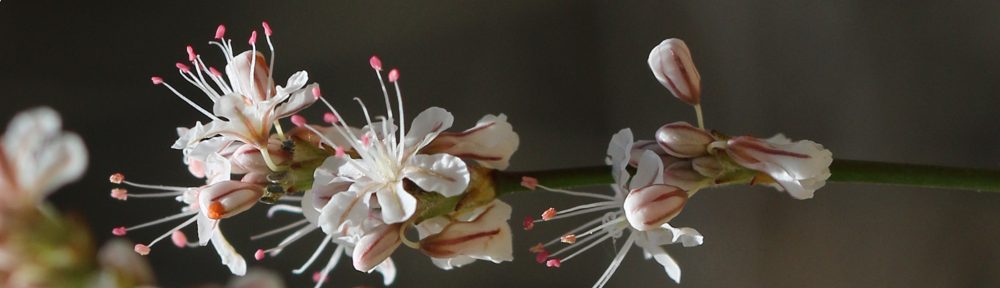
Plants subshrubs or shrubs, 2–10 dm tall, 3–10 (15) dm across; leaves cauline 1⁄2 or more length of flowering stem, the petioles 0.5–1 cm long, the blades lanceolate to oblanceolate or elliptic, 1–4 cm long, 0.5–1.5 cm wide, usually densely tomentose abaxially, floccose or nearly glabrous and greenish adaxially; inflorescences 3–10 cm long, the branches tomentose to floccose; involucres 1–2 mm long, 1–1.5 (2) mm wide; flowers 1.5– 2.5 mm long, the perianth usually pale yellow to yellow, sometimes white, glabrous. 2n = 40.
Author Archives: xochipelli2012
Eriogonum wrightii var. wrightii
Plants subshrubs or shrubs, (1) 1.5–5 (7.5) dm tall, 1–12 (18) dm across; aerial flowering stems mostly tomentose; leaves with petiole bases not forming distinct ring around stem, the blades oblanceolate to elliptic, 0.5–1.5 cm long, 0.2–0.5 (0.7) cm wide, the margins usually plane; inflorescences virgate or cymose, the branches slender; involucres 1 per node, turbinate to narrowly campanulate, 2–2.5 mm long; flowers 2.5–3.5 mm long, the perianth white to pink or rose, the hypanthium 1⁄4 length of perianth, the tepals monomorphic or nearly so, obovate, the stamens exserted, 1.5–4 mm long, the filaments glabrous or sparsely pilose proximally; achenes 2.5–3 mm long. Continue reading
Eriogonum thomasii
Plants herbs, spreading, annual, 0.5–3 dm tall, glabrous, greenish, sometimes grayish or reddish; stems with caudex absent, the aerial flowering stems erect, solid, not fistulose, 0.2–1 dm long, glabrous except for few glands proximally; leaves basal, the petioles 0.5–3 cm long, the blades round to round-reniform, cm long, 0.5– 2 cm long and wide, densely white-tomentose abaxially, floccose to glabrate and greenish adaxially, the margins plane; inflorescences cymose, open to diffuse, 5–25 cm long and wide, the branches glabrous, the bracts 3, scalelike, 1–2.5 mm long, 1–2 mm wide; peduncles capillary, spreading to slightly recurved, straight or curved, capillary, 0.5–3 cm long, glabrous; involucres turbinate-campanulate, 0.6–1.2 mm long, 0.7–1.3 mm wide, glabrous, the teeth 5, erect, 0.4–0.6 mm long; flowers 0.8–1 mm long in early anthesis, becoming 1.2–2 mm long, the perianth yellow in early anthesis, becoming white to rose, short-hispidulous, the tepals dimorphic, those of outer whorl cordate, becoming saccate-dilated proximally, those of inner whorl spatulate, the stamens included, 0.5–0.9 mm long, the filaments mostly glabrous; achenes brown to dark brown, usually lenticular, 0.8–1 mm long, glabrous. 2n = 40.
Eriogonum arizonicum
Plants herbs, erect to slightly spreading, perennial, 2.5–5 (6) dm tall, 3–8 dm across, glabrous, glaucous; stems with caudex compact to spreading, the aerial flowering stems erect, solid, not fistulose, 1–3 dm long, glabrous or thinly floccose; leaves basal, sheathing up stems 0.5–15 cm, the petioles (0.5) 1–2.5 (4) cm long, densely pilose, the blades ovate to rounded, (0.5) 1–2 (2.3) cm long, (0.5) 1–2 (2.5) cm wide, usually sparsely pilose and grayish to whitish on both surfaces, the margins undulate; inflorescences narrowly cymose, open, 10–35 (40) cm long, 5–20 cm wide, the branches not fistulose, glabrous, glaucous, the bracts 3, scalelike, 0.3–0.8 (1) mm long, 0.2–0.8 mm wide; peduncles erect, straight, capillary to slender, 0.5–2.5 (3) cm long, glabrous; involucres turbinate, (0.8) 1–1.6 (2) mm long, (0.8) 1–1.2 (1.5) mm wide, glabrous, the teeth 5, erect, 0.3–0.8 mm long; flowers (1.2) 1.5–2.5 mm long, the perianth yellowish to yellowish-red or reddish with greenish or reddish to reddish-brown midribs, glabrous, the tepals dimorphic, those of outer whorl obovate with slightly enlarged, auriculate bases, those of inner whorl obovate, the stamens included, 1–1.5 mm long, the filaments sparsely pilose proximally or glabrous; achenes dark brown, trigonous, 1.5–2 mm long, glabrous.
Eriogonum jamesii var. jamesii
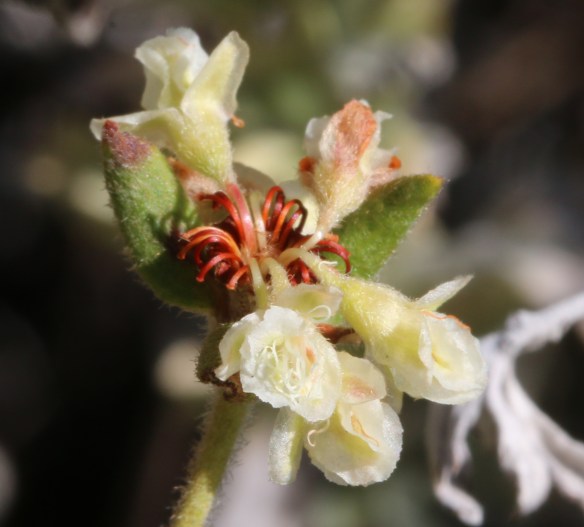
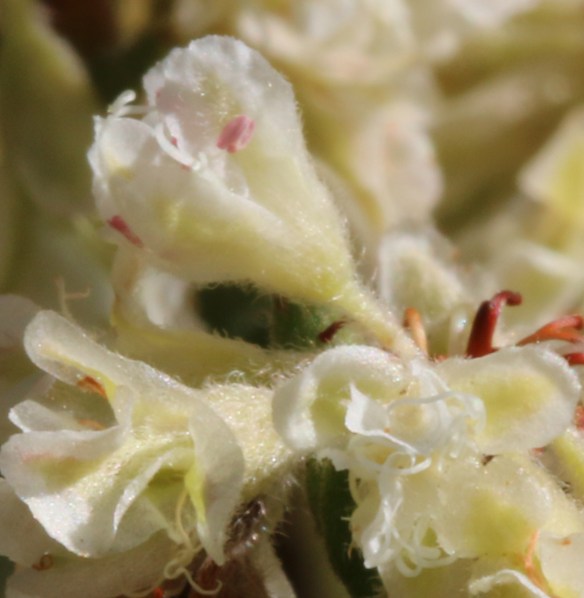
Plants herbs or subshrubs, compact or spreading, matted, 0.5–2.5 dm tall, 3–15 dm across, tomentose to floccose; stems with caudex absent or spreading, the aerial flowering stems erect, slender, solid, not fistulose, usually arising directly from a taproot, 0.5–1.5 dm long, tomentose to floccose; leaves basal, typically not in rosettes, the petioles 0.5–6 cm long, tomentose to floccose, the blades usually narrowly elliptic, 1–3 (3.5) cm long, (0.3) 0.5–1 (1.2) cm wide, densely tomentose abaxially, thinly tomentose, floccose or glabrous and grayish to greenish adaxially, the margins entire, plane or undulate and crisped; inflorescences compound-umbellate, branched 2–5 times, the bracts usually semi-foliaceous, those of proximal node 0.5–2 cm long, 0.3–1 cm wide; involucres 4–7 mm long, 2–5 mm wide, tomentose to floccose, the teeth 5–8, erect, 0.1–0.5 mm long; flowers 3–8 mm long, including a 0.7–2 mm long stipelike base, the perianth white to cream, densely pubescent abaxially, the tepals dimorphic, those of outer whorl lanceolate to elliptic, 2–5 mm long, 1–3 mm wide, those of inner whorl lanceolate to fan-shaped, 1.5–6 mm long, 2–4 mm wide, the stamens exserted, 2–4 mm long, the filaments pilose proximally; achenes light brown to brown, 4–5 mm long, glabrous except for sparsely pubescent beak.

Fowers : 3–8 mm long, including a 0.7–2 mm long stipelike base, the perianth white to cream, densely pubescent abaxially.
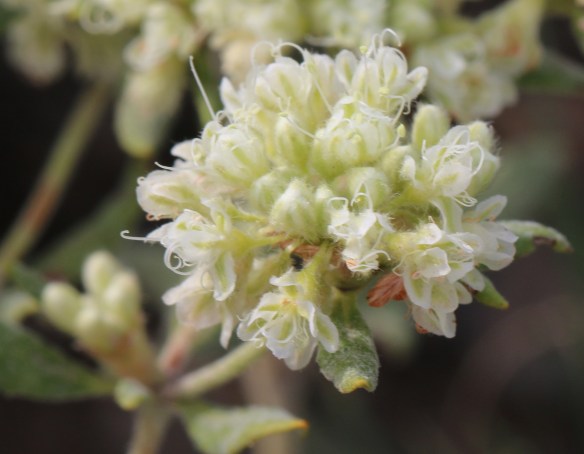

Flowering Jun-Oct. Sandy to gravelly or infrequently rocky flats and slopes, mixed grassland, saltbush, blackbrush, creosote bush, mesquite, and sagebrush communities, oak, pinyon and/or juniper, and montane conifer woodlands; (1000) 1300–2900 (3100) m.








Eriogonum polycladon
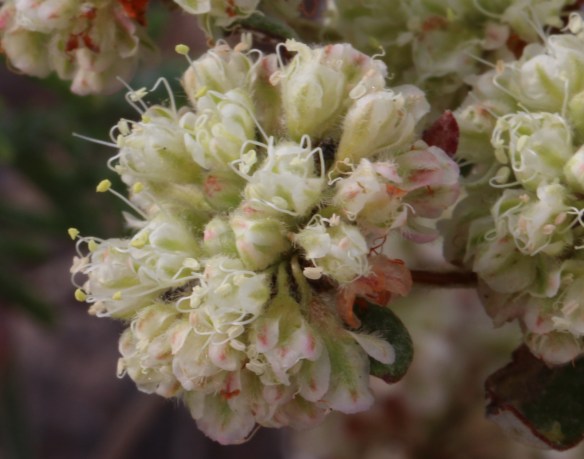
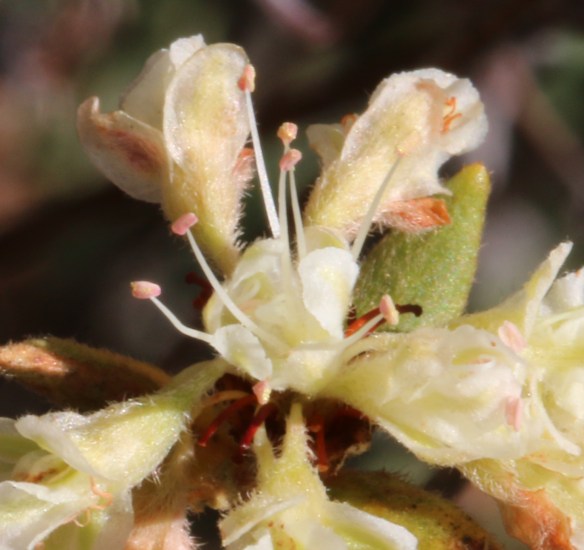
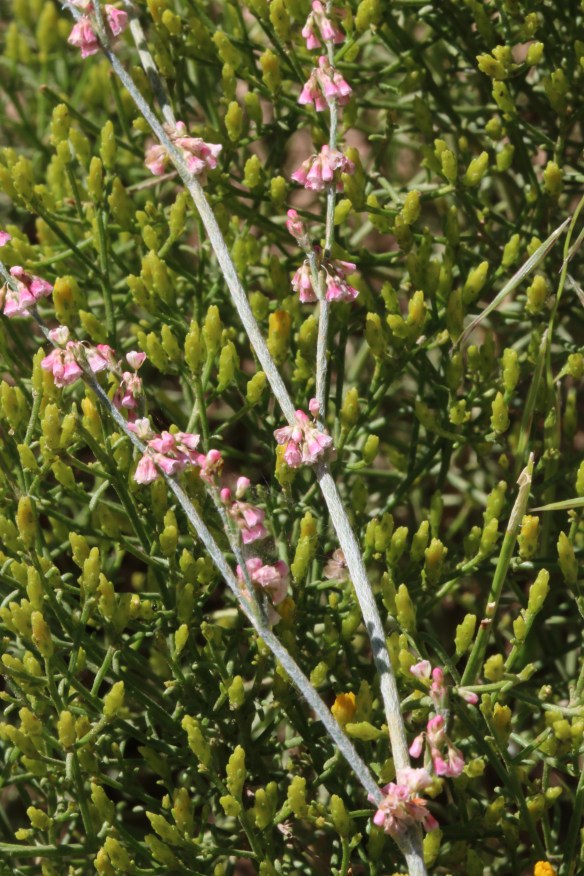
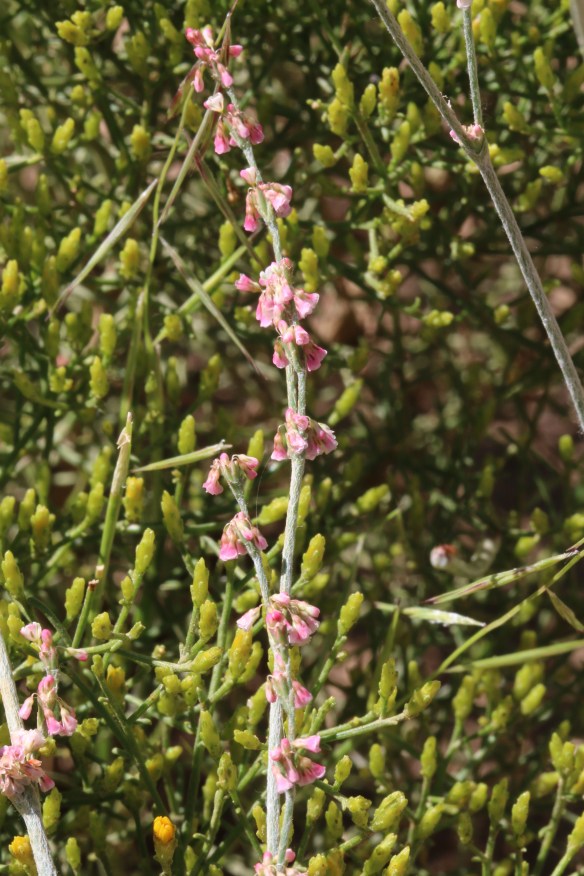
Plants herbs, narrowly erect, (0.5) 1–6 dm tall, tomentose, whitish to grayish; aerial flowering stems erect, (0.3) 1–3 dm long, tomentose; leaves cauline, the petioles 0.3–1.5 cm long, the blades narrowly oblanceolate to broadly elliptic, (0.7) 1–3 cm long, 0.5–1.5 cm wide, densely white-tomentose and whitish to grayish on both surfaces; inflorescences narrowly cymose, distally uniparous due to suppression of secondary branches, open, (5) 10–50 cm long, 10–25 cm wide, the branches tomentose, the bracts 1.5–3 mm long, 1–2.5 mm wide; peduncles absent; involucres appressed to branches, turbinate, 1.5–2.5 mm long, 1–2 mm wide, tomentose, rarely glabrous, the teeth 5, erect, 0.4–1 mm long; flowers (1) 1.5–2 mm long, the perianth white, becoming pink or red, glabrous, the tepals dimorphic, those of outer whorl broadly fan-shaped, those of inner whorl oblanceolate, the stamens included, 1–1.5 mm long, the filaments pilose proximally; achenes dark brown, trigonous, 1–1.3 mm long. 2n = 26.

Flowering year-round. Sandy to gravelly washes, flats, and slopes, saltbush, creosote bush, greasewood, blackbrush, and sagebrush communities, oak, pinyon and/or juniper, and montane conifer woodlands; (200) 500–2200 (2500) m.

Eriogonum capillare
Plants herbs, erect, annual, (1) 2–4 dm tall, glabrous; stems with caudex absent, the aerial flowering stems erect, solid, not fistulose, 0.5–1.5 dm long, glabrous; leaves basal, the petioles 1–3 cm long, sparsely villous, the blades obovate to round, 1–3 cm long and wide, sparsely villous to hirsute and greenish to grayish on both surfaces, the margins plane; inflorescences cymose, usually dense, 10–30 cm long, 5–35 cm wide, the branches not fistulose, glabrous, the bracts 3, scalelike, 0.5–3 mm long, 0.5–2.5 mm wide; peduncles erect, straight, slender, 1–3 cm long, glabrous; involucres campanulate, 1–1.5 mm long and wide, glabrous, the teeth 5, erect, 0.2–0.4 mm long; flowers 1–1.6 mm long, the perianth white with greenish or reddish midribs, becoming pink to rose, glabrous, the tepals dimorphic, those of outer whorl pandurate with swollen, auriculate bases, those of inner whorl oblanceolate, the stamens included to exserted, 0.8–1.2 mm long, the filaments glabrous; achenes shiny brown to black, trigonous, 1.3–1.6 mm long, glabrous.
Eriogonum pharnaceoides var. pharnaceoides
Plants herbs, erect or spreading, annual, 1–5 dm tall, villous, greenish, yellowish-green, or reddish; stems with caudex absent, the aerial flowering stems erect or nearly so, solid, not fistulose, 0.1–0.8 dm long, villous; leaves basal and cauline; basal: petiole 0.1–0.5 (1) cm long, blade linear-lanceolate to linear-oblanceolate, 1–4 cm long, 0.1–0.4 cm wide, white-lanate abaxially, villous and greenish to yellowish-green adaxially, the margins plane or revolute; cauline: sessile, blade linear, 0.5–2.5 cm long, 0.05–0.3 cm wide, tomentose abaxially, thinly villous or glabrous and greenish adaxially; inflorescences cymose, open, 5–45 cm long, 3–40 cm wide, the branches villous, the bracts 3–8, semi-foliaceous, 5–15 mm long, 0.3–1.5 (2) mm wide; peduncles erect or nearly so, straight, slender, (1) 2–5 (7) cm long, sparsely villous or glabrous; involucres campanulate, 1–2 mm long, 2–3 mm wide, villous, the teeth 5, mostly erect to spreading, 1–3 mm long; flowers 1–3 mm long, the perianth white to rose or yellow, sometimes becoming reddish, glabrous, the tepals dimorphic, those of outer whorl oblong-ovate, 2–saccate-dilated proximally, those of inner whorl linear- oblong, the stamens mostly included, 1–1.5 mm long, the filaments mostly pilose proximally; achenes brown to blackish, lenticular, 1.8–2 mm long, glabrous.
Eriogonum pharnaceoides var. cervinum
In the Mount Trumbull area, on September 19 th 2014, I looked all the evening for this variety but to no avail. So, the following day, I went all the way to the top of Mount Trumbull but I could not find it anywhere either. I was disappointed – because it is a very long way to get in the heart of the Mohave Desert just for one Eriogonum – for which there was not even a single live picture on the web, or in Jim’s Manual, except one of a dry plant in a herbarium. In 1974, Jim wrote: «As I indicated before (Reveal, 1973), the problem with this variety has been the paucity of material for critical evaluation and use as a type. In 1973, Atwood and Larry C. Higgins obtained specimens of this variant for me, and they succeed rather well. In addition, a visit to the Grand Canvon National Park resulted in the discovery of var. cervinum in northern Arizona, and thus the known range can be expanded to include this state for the variety». So, in 2014, there was still nothing available as a descriptive picture. And that is why Jim had requested some for his next edition.
But well, after my unsuccessful escapade on the mountain, I decided to go back to the valley taking BLM 1018 west and, while driving a little way, all of a sudden, my eyes were attracted by a tiny plant in the sand. Here it was (36°24’3″ N / 113°10’52” W) and some of these Eriogonum pharnaceoides var. cervinum were just a few centimeters high and fully blooming. And then, I realized that I had seen some, early in the morning, at the start of the trail going to Mount Trumbull. But I was not awakened to the minute nature of some of the plants, of this variety – which are less than 10 cm high and the tallest being 45 cm, in the Mount Trumbull area. Or I was not awakened at all to the Nature of this variety – awakening requires, sometimes, some kind of a “psychic taming”.
Eriogonum nudum var. indictum
Plants 5–8 (10) dm tall; aerial flowering stems strongly fistulose, 2.5–3.5 dm long, glabrous; leaves sheathing, the blades 1–6 cm long, 1–2 (3) cm wide, densely tomentose abaxially, less so to floccose adaxially, the margins strongly undulate-crisped; inflorescences cymose, 25–50 cm long, 15–25 cm wide, the branches glabrous; involucres 1 per node, 4–5 mm long, glabrous; flowers 2.5–3 mm long, the perianth pale yellowish- white to yellow or white, glabrous. 2n = 80.
 Eriogoneae
You must be logged in to post a comment.