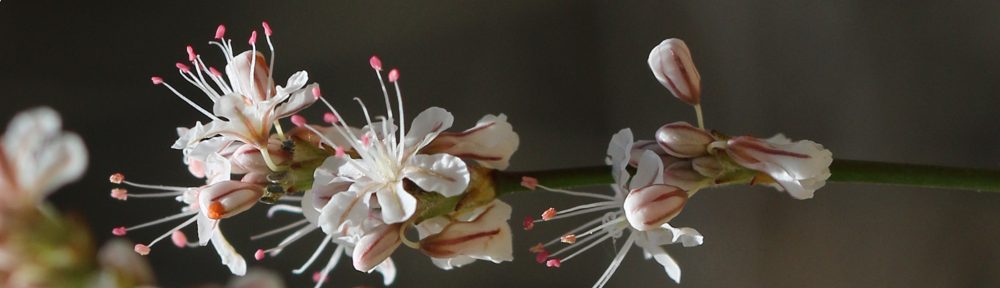
Plants herbs, erect, 1.5–3 dm tall, 1–4 dm across, tomentose, brownish; stems slightly spreading to erect, without persistent leaf bases, up to 1/5 height of plant, the caudex stems absent, the aerial flowering stems erect, slender, solid, not fistulose, 0.5–1.5 dm long, tomentose; leaves basal, 1 per node, the petioles 1–5 cm long, tomentose, the blades elliptic to ovate or obovate, 1.5–4 cm long, 1–2.5 cm wide, white-tomentose abaxially, less so and often greenish adaxially, the margins plane; inflorescences cymose with involucres racemosely disposed at tips, (10) 12–20 cm long, 1–5 cm wide, the branches dichotomous, tomentose, the bracts 3, scalelike, narrowly triangular, 1–4 mm long, or foliaceous, elliptic to oval, 5–15 mm long, 5–15 mm wide; peduncles absent; involucres 1 per node, turbinate, 3–5 mm long, 2–4 mm wide, tomentose, the teeth 5, erect, 0.4–0.8 mm long; flowers 3.5–5 mm long, the perianth white to whitish-brown, glabrous, the hypanthium 1⁄4 length of perianth, the tepals monomorphic, oblanceolate, the stamens exserted, 3–7 mm long, the filaments pilose proximally; achenes light brown, 2.5–3 mm long, glabrous.
Author Archives: xochipelli2012
Eriogonum heermannii var. argense
Plants shrubs, spreading to rounded, sparsely to densely branched, 1–10 dm tall, 2–10 (12) dm across; leaf blades linear to linear-lanceolate or oblanceolate to elliptic or oblong, 0.5–1.2 (1.5) cm long, 0.1–0.6 cm wide, tomentose or glabrous abaxially; inflorescences (1) 3–20 cm long, (1) 3–25 cm wide, the branches diffuse with racemosely arranged involucres at tips, slender to stout, round, smooth, glabrous, scabrellous, or infrequently papillate-scabrous, infrequently somewhat spinose; involucres narrowly turbinate to campanulate, 0.9–1.8 mm long, 0.7–1.3 mm wide; flowers 1.5–4 mm long, the perianth white to yellowish-white or reddish, the tepals glabrous. Continue reading
Eriogonum wrightii var. trachygonum
Plants subshrubs, 1.5–4 dm tall, 1–5 dm across; aerial flowering stems mostly densely tomentose; leaves with petiole bases not forming distinct ring around stem, the blades elliptic, 1.5–3 cm long, 0.5–1 cm wide, the margins usually plane; inflorescences virgate or cymose, the branches dichotomous, usually stout; involucres 3–4 mm long; flowers 3–4 mm long, the perianth white to pink or rose; achenes 2.5–3 mm long. Continue reading
Eriogonum umbellatum var. nevadense
Plants subshrubs, mostly spreading, 1–5 dm tall, 2–6 dm across; aerial flowering stems erect, 1–3 dm long, thinly tomentose to nearly glabrous, without one or more foliaceous bracts about midlength; leaves in rather open rosettes, the blades usually elliptic, 1–2 (2.5) cm long, 0.5–1.5 cm wide, thinly tomentose to floccose abaxially, less so to thinly floccose or glabrous and green adaxially, the margins plane; inflorescences umbellate, the branches 0.3–3 (5) cm long, thinly tomentose to subglabrous, without a whorl of bracts about midlength; involucral tubes 2–3.5 mm long, the lobes 1.5–3.5 mm long; flowers 4–7 mm long, the perianth bright yellow. 2n = 80.
Eriogonum breedlovei var. breedlovei
I drove up, from Kelso Valley Road, in Kern County – looking for Eriogonum breedlovei var. breedlovei, on July 12 th 2014 – to Claraville and Piute Peak with my 27 feet long RV, which was not reasonable but fairly easy and sandy. But, at the end of the day, after getting lost twice on the National Forest Roads, when it was time to return, I decided to go down towards Lake Isabella on the Piute Mountain Road (Saddle Spring Road). It was pretty scary, the brakes were very hot ; and it got more scary when I had to manage a series of hairpin turns, just after Rocky Point. I was almost ready to back up and I understood, then, why the people in Claraville were looking funny at me in my long RV – when I got there. I did a lot of crazy things with this RV, in the deserts and in the mountains of the western USA, but that day, the descent was the most dangerous I ever did with such a vehicle (which is not meant to be used as a 4WD!). It was a very long drop: from 2500 m to 800 of altitude. And when they call it a road, I have seen a lot better in the Aïr desert region of Niger… In this case, no choice, you need to drive the European way, in first drive, to multiply, at least three times, your precious braking time… before the smoke of your arch-burning brakes alerts some lonely ranger on the top of a fire watch tower! I had to stop many times to let the brakes cool down and, that time, I really wondered if I could make it down to Lake Isabella… with the vehicle safe and sound. As I was ready to jump down… with the door opened. I am an Eriogonum Stalker!
Eriogonum plumatella
Plants shrubs, erect, not scapose, 3–10 (12) dm tall, 3–6 (8) dm across, tomentose or glabrous, grayish or greenish; stems erect, without persistent leaf bases, up to 1⁄2 or more height of plant, the caudex stems absent, the aerial flowering stems erect, slender, solid, not fistulose, 0.5–2 dm long, tomentose or glabrous; leaves basal and cauline, 1 per node, the petioles 0.1–0.5 cm long, mostly tomentose, the blades oblanceolate, 0.6–1.5 cm long, 0.2–0.3 cm wide, tomentose on both surfaces, occasionally slightly less so adaxially, the margins plane; inflorescences cymose, flat-topped and in tiers, 15–40 cm long and wide, the branches dichotomous, divaricately arranged in a zig-zag pattern, tomentose or glabrous, the bracts 3, scalelike, 1–7 mm long; peduncles absent; involucres 1 per node, turbinate, 2–2.5 mm long, 1.5–2 mm wide, glabrous, the teeth 5, erect, 0.4–0.6 mm long; flowers 2–2.5 mm long, the perianth white to pale yellow, glabrous, the hypanthium 1⁄4 dimorphic, those of outer whorl obovate, those of inner whorl oblong, the stamens exserted, 2–4 mm long, the filaments pilose proximally; achenes light brown to brown, 2.5–3 mm long, glabrous.
Eriogonum clavatum
Plants herbs, erect, annual, (2) 4–18 (22) dm tall, glabrous, bright green; stems with caudex absent, the aerial flowering stems erect, hollow and fistulose, 0.5–3.5 (5) dm long, glabrous, minutely glandular proximally, infrequently also short-hispid; leaves basal, the petioles 1–6 cm long, hirsute, the blades round to reniform, (0.5) 1–2.5 (4) cm long, (0.5) 1–2 (3) cm wide, short-hirsute on both surfaces and greenish, the margins plane; inflorescences cymose, open, spreading to erect, 30–150 (170) cm long, 10–80 cm wide, the branches usually fistulose, glabrous, the bracts 3, scalelike, 1–4 mm long, 1–2 mm wide; peduncles mostly spreading, straight, slightly bent distally, capillary, 1–4 cm long, glabrous; involucres turbinate, 1–1.5 (1.8) mm long, 0.6–0.9 (1.2) mm wide, glabrous, the teeth 4, erect, 0.3–0.5 mm long; flowers 1.5–2.5 mm long, the perianth yellow with greenish to reddish midribs, densely hirsute with coarse curved hairs, the tepals monomorphic, narrowly ovate, the stamens exserted, 0.9–1.5 mm long, the filaments glabrous or sparsely pubescent proximally; achenes light brown to brown, trigonous, 2–2.5 mm long, glabrous. 2n = 32.
Eriogonum palmerianum
Plants herbs, spreading to erect, (0.5) 1–3 dm tall, mostly floccose to tomentose, grayish to tawny; aerial flowering stems mostly erect, 0.3–0.8 dm long, floccose to tomentose; leaves basal, the petioles 1–4 cm long, floccose, the blades suborbiculate to cordate, 0.5–1.5 (1.8) cm long, 0.5–2 cm wide, densely white- to grayish- tomentose abaxially, less so to glabrate and often greenish adaxially; inflorescences cymose, distally uniparous due to suppression of secondary branches, open, 5–2.5 cm long, 10–30 cm wide, the branches not inwardly curved distally, floccose to tomentose, the bracts 0.5–3 mm long, 1–3 mm wide; peduncles absent; involucres appressed to branches, campanulate, 1.5–2 mm long and wide, floccose to tomentose, the teeth 5, erect, 0.2– 0.3 mm long; flowers 1.5–2 mm long, the perianth white to pink or pale yellowish, becoming pink to red, glabrous, the tepals dimorphic, those of outer whorl narrowly fan-shaped, those of inner whorl oblanceolate, the stamens included, 1–1.5 mm long, the filaments pilose proximally; achenes brown, trigonous, 1.5–1.8 mm long. 2n = 40.
Flowering Mar-Oct. Sandy to gravelly washes, flats, and slopes, saltbush, greasewood, creosote bush, blackbrush, and sagebrush communities, pinyon and/or juniper woodlands; (300) 600–2300 (2700) m.
Eriogonum fasciculatum var. polifolium
Plants shrubs or subshrubs, compact to spreading, 2–5 (8) dm tall, 2–20 (30) dm across, tomentose to canescent and grayish; aerial flowering stems thinly tomentose to canescent, rarely glabrous; leaf blades usually oblanceolate, 0.6–1.8 cm long, (0.1) 0.2–0.6 cm wide, canescent on both surfaces or densely grayish- tomentose abaxially and canescent adaxially, the margins plane or infrequently revolute; inflorescences capitate to cymose-umbellate, rarely cymose, the branches tomentose to canescent, rarely glabrous; involucres turbinate-campanulate to campanulate, 2.5–3.5 mm long, 2–3 mm wide, canescent; perianth pubescent. 2n = 40.
Eriogonum gracilipes
Plants herbs, matted, scapose, 0.5–1 dm tall, 0.5–2 dm across; stems matted, with persistent leaf bases, up to 1/5 height of plant, the caudex stems matted, the aerial flowering stems scapelike, erect, slender, solid, not fistulose, (0.2) 0.3–1 (1.2) dm long, glandular-hairy; leaves basal, fasciculate in terminal tufts, the petioles (0.5) 0.8–1.7 (2) cm long, thinly tomentose, glandular, the blades oblanceolate to elliptic, (0.3) 1–1.5 (2) cm long, (0.2) 0.3–0.6 cm wide, densely white-tomentose and glandular abaxially, less so and greenish adaxially, the margins plane; inflorescences capitate, 1–2 cm long, the branches absent, the bracts 3–5, lanceolate, scalelike, 1.5–3 mm long; peduncles absent; involucres 5–7 per cluster, turbinate to campanulate, 2–4 mm long, 2–3 mm wide, membranous, sparsely glandular to glandular-puberulent or pubescent, the teeth 5, erect to spreading, 1–1.5 mm long; flowers 2–3 mm long, the perianth white to rose, glandular, the hypanthium 4 length of perianth, the tepals monomorphic, obovate, the stamens exserted, 2–3.5 (4) mm long, the filaments pilose proximally; achenes light brown, 2–2.3 (2.5) mm long, glabrous. Continue reading
 Eriogoneae
You must be logged in to post a comment.