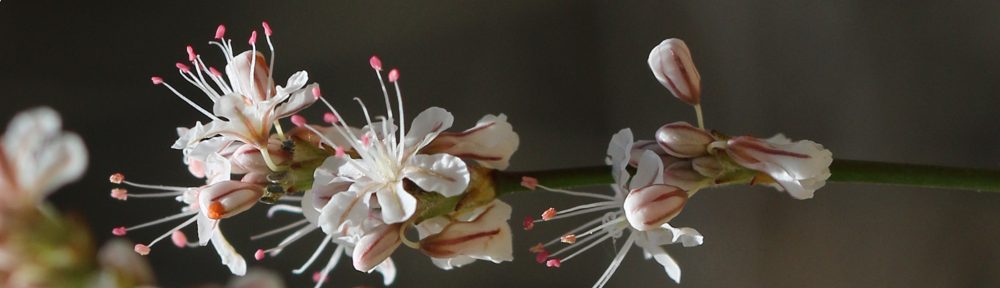
Plants herbs, erect, (1.5) 2.5–4.5 (5) dm tall, 1–2 dm across, glabrous; stems with caudex absent or nearly so, the aerial flowering stems erect, slender, solid, not fistulose, arising at nodes of caudex branches and at distal nodes of short, nonflowering aerial branches, 1–4 dm long, essentially glabrous; leaves basal, occasionally in rosettes, the petioles 1–4 (7) cm long, pilose, the blades elliptic-obovate to round-ovate, 1–3 (3.5) cm long, 0.8–2.5 cm wide, pilose, the margins entire, plane; inflorescences capitate, 2–3.5 (4) cm wide, the branches absent, the bracts 5–8, essentially scalelike, 1–8 mm long, 1–3 mm wide; involucres 2–5 or more per cluster, campanulate, 6–8 mm long and wide, pilose, the teeth 5–8, erect to slightly spreading, 1–2 mm long; flowers 3–6 mm long, including a 0.1–0.2 mm long stipelike base, the perianth cream to pale yellow, sparsely pubescent abaxially, the tepals monomorphic, obovate to spatulate, the stamens exserted, 3–7 mm long, the filaments pilose proximally; achenes light brown, 3–5 mm long, glabrous. Continue reading
Author Archives: xochipelli2012
Eriogonum rupinum
Plants herbs, erect, 3–5 dm tall, 0.5–1 dm across, tomentose, brownish; stems slightly spreading to erect, without persistent leaf bases, up to 1/5 height of plant, the caudex stems absent, the aerial flowering stems erect, slender, solid, not fistulose, 1.5–2.5 dm long, tomentose; leaves basal, 1 per node, the petioles (2) 3–7 cm long, tomentose, the blades elliptic to oblong, (2) 2.5–4.5 (5) cm long, 1.5–3.5 (4) cm wide, thinly tomentose abaxially, less so to floccose and greenish adaxially, the margins plane; inflorescences cymose, with involucres racemosely disposed at tips, 15–25 cm long, 5–15 cm wide, the branches dichotomous, tomentose, the bracts 3, scalelike, triangular, 2–4 mm long; peduncles absent; involucres 1 per node, turbinate-campanulate, 3–4 mm long and wide, tomentose, the teeth 5, erect, 0.1–0.3 mm long; flowers 2.5–4.5 (5) mm long, the perianth creamy white or cream, glabrous, the hypanthium 1⁄4 length of perianth, the tepals monomorphic, broadly oblanceolate, the stamens exserted, 2.5–5 mm long, the filaments pilose proximally; achenes light brown, 2–4 mm long, glabrous. 2n = 40.
Eriogonum kennedyi var. purpusii
Plants herbs, densely matted, 0.4–1.2 dm tall, 1–3 dm across, leaf blades elliptic, (0.25) 0.3–0.6 cm long, 0.15–0.35 cm wide, white-tomentose on both surfaces, the margins not revolute; scapes 0.4–1 cm long, glabrous or rarely floccose; involucres 1.5–2 mm long, glabrous or sparsely tomentose; flowers 2–2.5 mm long; achenes 2.5–3 mm long.
Flowering May-Jul. Sandy flats and slopes, mixed sagebrush and grassland communities, pinyon, juniper, and Jeffrey pine woodlands; 1500–2500 m; Inyo and southern Mono cos. of California, near Inyokern in Kern Co., California, and in the Orchard Springs area of Esmeralda Co., Nevada.
Eriogonum nummulare
Plants shrubs, spreading or rarely sprawling, not scapose, (1.5) 3–8 (10) dm tall, 3–12 (15) dm across, tomentose or rarely floccose to glabrate, grayish; stems decumbent to spreading, often without persistent leaf bases, up to 1⁄3 height or more of plant, the caudex stems absent or spreading in moving sand, the aerial flowering stems spreading, slender to stout, solid, not fistulose, 0.5–1 dm long, tomentose to floccose; leaves cauline, 1 per node, the petioles 0.2–1 cm long, tomentose to floccose, the blades broadly oblanceolate to elliptic or, rarely, orbiculate, (0.5) 1–3 cm long, 0.4–1.2 (1.5) cm wide, densely white-tomentose abaxially, less so and greenish adaxially, the margins plane; inflorescences cymose, open, 5–50 cm long, 5–80 cm wide, the branches dichotomous proximally, often with involucres racemosely arranged distally, tomentose to thinly floccose, rarely glabrate, the bracts 3, scalelike, linear to triangular, 0.5–6 mm long; peduncles absent or erect, 0.5–3 cm long, tomentose; involucres 1 per node, turbinate to turbinate-campanulate, 2–3 mm long, 1.5–2.7 mm wide, tomentose or nearly so, the teeth 5, erect, 0.1–0.4 mm long; flowers 1.5–3 mm long, the perianth white, glabrous, the hypanthium 1⁄4 length of perianth, essentially monomorphic, obovate, the stamens slightly to long-exserted, 2–5 mm long, the filaments subglabrous or sparsely puberulent proximally; achenes light brown, 2–3 mm long, glabrous. 2n = 80.
Eriogonum cernuum
Ethnobotany. According to the book “The Ethnobotany of the Kayentah Navaho” (Wyman, Leland C. and Stuart K. Harris. The University of New Mexico Press. 1951), Eriogonum cernuum was used for skin rashes and for kidney diseases. The seeds were made into a mush for food.
According to the book “The Ethnobotany of the Ramah Navaho” (Vestal, Paul A., 1952, Papers of the Peabody Museum of American Archaeology and Ethnology), Eriogonum cernuum was used as a poultice of chewed leaves applied to red ant bite.
According to the book “CRC World Dictionnary of Medicinal and Poisonous Plants” (Umberto Quattrocchi), Eriogonum cernuum was used also as a tonic and a antiseptic.
With the Gosiute Peoples of Nevada and Utah, Eriogonum cernuum is called “Oi’tcu-mo”, from Oi’tcu for bird, and Mo’a for leg.
In the Bear Medecine of the Tewa (Pueblo) of New Mexico, Eriogonum cernuum – “poe unipi” – is used as a birth plant: a decoction of the plant is given after the birth. The other species used by the midwives are the following: Gilia rigidula; Phoradendron juniperum; Gutierrezia sarothrae; Croton texensis; Aquilegia caerulea; Dyssodia papposa; Euphorbia serpyllifolia; Mentzelia pumila; Asclepias latifolia; Malva parviflora.
In “Navajo Indian Medical Ethnobotany” (University of New-Mexico Bulletin. 1941), authored by Leland C. Wyman and Stuart K. Harris, we find the following: Diseases (especially kidney and bladder disease, sudoresis, and stomach distress) attributed to swallowing a red ant (in food or water), or to other types of “red ant infection,” may be treated by Red Ant Way; hence plants used for these conditions may pertain to this Chant Way. Decoctions or infusions of the plants are taken internally and are said to “kill the ant.” Itching and sores caused by red ant bites are treated by applying decoctions or infusions as lotions, or by chewing the leaves of the plants and applying them as poultices. The plants may be designated by the Navajo names “red ant medicine” {1} “red ant killer” {2} “red ant food” {3} or included in the Navajo family or form genus “red ant decoction” {4}. See diuretics.
- {1} wóláchííʼ azee (c’il) – red ant medicine. Dyssodia accrosa; Dyssodia papposa; Gaura coccinea; Viguiera multiflora; Lepachys tagetes; Polygonum aviculare.
- {2} wóláchííʼ be-tkah – red ant killer: Grindelia aphanactis.
- {3} wóláchííʼ da – red ant food: Erlogonum cernum; Grindelia aphanactis; Androsacae septentrionalis, var. puberulenta var. glandulosa; Arenalia fendleri; Erigeron divergens; Euphorbia novomexicana; Oxybaphus spp.; Psilactis asterioides. Various botanical species of a “spidery” habit are often included in this group as generalizations, often being the same as those in the groups of “spider plants”. See {5} and {6}.
- {4} wóláchííʼ yiłbéézh – red ant decoction: Actinea leptoclada, var. ivesiana; Coreopsis cardaminefoiia; Corispermum hyssopifolium; Dyssodla accrosa; Eriogonum cernuum; Menodora scabra; Paronychia jamesii; Polygala alba; Silene pringlei; Tetraciea coulteri; Thelesperma longipes; Thelespermas ubnudum.
- {5} naʼashjéʼii c’il – spider plant: Androsacae septentrionalis var. puberulenta; Arenaria fendleri; Astragalus hosackiae; Hoffmanseggia drepanocarpa; Linum puberulum; Polygonum aviculare; Potentilla pennsylvanica; Potentilla propinqua.
- {6} naʼashjéʼii da – spider food: Androsacae septentrionalis var. puberulenta var. glandulosa; Boerhaavia sp.; Bouteloua eriopoda; Cladothryx lanuginosa: Galium fendleri; Gaura coccinea; Hoffmanseggia drepanocarpa; Petalostemum oligophyllum; (Vesicaria fendleri; Croton texensis) The last two groups include plants with a “spidery'” habit. Androsacae spp. may be.
Description from Jim Reveal’s Manual. Plants herbs, spreading to erect, annual, 0.5–6 dm tall, glabrous, grayish, greenish or reddish; stems with caudex absent, the aerial flowering stems erect, solid, not fistulose, 0.3–2 dm long, glabrous; leaves basal or sheathing up stems 2–10 cm, the petioles 1–4 cm long, tomentose, the blades round-ovate to orbiculate, (0.5) 1–2 (2.5) cm long and wide, white- to grayish-tomentose abaxially, tomentose to floccose or glabrate and grayish or greenish adaxially, the margins plane; inflorescences cymose, open to diffuse, 5–50 cm long, 5–40 cm wide, the branches glabrous, the bracts 3, scalelike, 1–2 mm long, 1–2.5 mm wide; peduncles spreading to ascending or deflexed to cernuous, infrequently absent, straight or curved, slender, 0.1–2.5 cm long, glabrous; involucres turbinate, (1) 1.5–2 mm long, 1–1.5 mm wide, glabrous, the teeth 5, erect, 0.4–0.7 mm long; flowers 1–2 mm long, glabrous, the perianth white to pinkish, becoming rose to red, the tepals dimorphic, those of outer whorl pandurate, those of inner whorl obovate, the stamens mostly exserted, 1–2 mm long, the filaments pilose proximally; achenes light brown to brown, trigonous, 1.5–2 mm long, glabrous. Continue reading
Eriogonum alatum var. alatum (triste phase)
Plants 5–13 (17) dm tall; aerial flowering stems strigose; leaves basal, infrequently cauline, the basal leaves on strigose to woolly or glabrous, 2–6 cm long, the blades lanceolate to oblanceolate, (3) 5–15 cm long, 0.3–2 cm wide, strigose or glabrous except for margins and midveins, the cauline leaf blades 1–6 cm long; inflorescences 2–10 dm long, the branches thinly strigose, infrequently glabrous at maturity; peduncles strigose or nearly so; involucres strigose or rarely glabrous; perianth yellow to yellowish-green or brownish red; achenes 5–8 mm long, 3–6 mm wide. 2n = 40. Continue reading
Eriogonum zionis var. zionis (nobilis phase)
Plants herbs, erect to spreading, 3–8 (10) dm tall, 0.5–1.5 dm across, glabrous and glaucous, rarely tomentose, greenish; stems spreading to erect, without persistent leaf bases, up to 1/3 height of plant, the caudex stems absent, the aerial flowering stems erect to spreading, slender to stout, solid or hollow, often fistulose, 1–3 dm long, glabrous, rarely tomentose; leaves basal, 1 per node, the petioles 3–8 (10) cm long, tomentose to floccose, leaf blades oblong-ovate to ovate, 2–4.5 cm long, 0.5–2.5 cm wide, lanate to densely or sparsely tomentose abaxially, thinly floccose or glabrous and green adaxially, the margins plane; inflorescences narrowly virgate or racemose with involucres racemosely disposed throughout or at tips, 20–45 (60) cm long, 5–25 cm wide, glabrous, rarely tomentose, the branches dichotomous, upper secondaries suppressed and bearing (8) 10–15 (30) racemosely arranged involucres, the bracts 3, scalelike, triangular, and 2–7 mm long, or foliaceous, linear-oblanceolate or oblanceolate to elliptic, and 10–40 mm long, 5–25 mm wide; peduncles absent; involucres 1 per node, turbinate to turbinate-campanulate, 1.5–3 mm long, 1.5–2.5 mm wide, tomentose to nearly glabrous, the teeth 5, erect, 0.2–0.5 mm long; flowers 2–6 (7) mm long, the perianth white or yellowish, glabrous, the hypanthium 1⁄4 their length of perianth, the tepals monomorphic, oblong, the stamens exserted, 2–5 mm long, the filaments pilose proximally; achenes light brown, (3) 4–5 (6) mm long, glabrous. 2n = 40.
Eriogonum corymbosum var. nilesii
Plants shrubs, 3–12 dm tall, 4–23 dm across; leaves cauline 1⁄2 or more length of flowering stem, the petioles 0.3–1.5 cm long, the blades elliptic to oblong, 0.8–2.5 (3) cm long, 0.4–0.8 cm wide, white-lanate to densely white-tomentose abaxially, silvery-floccose adaxially; inflorescences 2–20 cm long, the branches floccose; involucres 1.5–2 mm long, 1–1.5 mm wide; flowers 2–3 mm long, the perianth yellow to pale yellow or, rarely, white, glabrous. Continue reading
Eriogonum corymbosum var. corymbosum
Plants subshrubs or shrubs, 3–10 dm tall, 3–10 dm across; leaves cauline 1⁄2 or more length of flowering stem, the petioles 0.2–0.6 (0.8) cm long, the blades lanceolate to oblanceolate or elliptic, 1–3 (4.5) cm long, (0.3) 0.5–1.5 cm wide, usually densely tomentose on both surfaces, sometimes less so and greenish adaxially; inflorescences 3–10 cm long, the branches tomentose to floccose; involucres 1.5–3.5 mm long, 1–2 mm wide; flowers 2–3.5 mm long, the perianth white to cream, glabrous. 2n = 40. Continue reading
Eriogonum microthecum var. simpsonii
Plants subshrubs or shrubs, erect to spreading, not scapose, 0.2–1.5 dm tall, (0.6) 1–13 (16) dm across, white- to tannish-tomentose, floccose, or glabrous; stems spreading to erect, typically without persistent leaf bases, up to 1⁄2 height of plant, the caudex stems absent or spreading, the aerial flowering stems erect to spreading, slender, solid, not fistulose, 0.05–1.5 dm long, lanate, tomentose, floccose, subglabrous, or glabrous; leaves cauline, 1 per node or fasciculate, the petiole 0.1–0.5 cm long, tomentose to floccose or glabrous, the blade usually elliptic, sometimes linear to obovate, 0.3–3.5 cm long, (0.07) 0.1–1.2 cm wide, tomentose abaxially, less so or glabrous adaxially, with occasionally revolute margins; inflorescences cymose, compact, often flat- topped, 0.5–6 (12) cm long, 1–10 (13) cm wide, the branches dichotomous, whitish-lanate to brownish- or reddish-tomentose to floccose or glabrate, infrequently green or gray and subglabrous or glabrous, the bracts 3, scalelike, linear to triangular, 1–5 mm long; peduncles absent or more often erect, slender, 0.3–1.5 cm long, tomentose to floccose; involucres 1 per node, turbinate, (1.5) 2–3.5 (4) mm long, 1.3–2.5 (3) mm wide, tomentose, floccose, subglabrous or glabrous, the teeth 5, erect, (0.3) 0.5–1 (1.7) mm long; flowers 1.5–3 (4) mm long, the perianth yellow or white to pink, orange, rose, red or, occasionally, cream, glabrous, the hypanthium 1/5–2/5 length of perianth, the tepals essentially monomorphic, oblong to obovate, the stamens usually exserted, 2.5–4 mm long, the filaments sparsely to densely puberulent proximally; achenes brown, 1.5–3 mm long, glabrous.
 Eriogoneae
You must be logged in to post a comment.