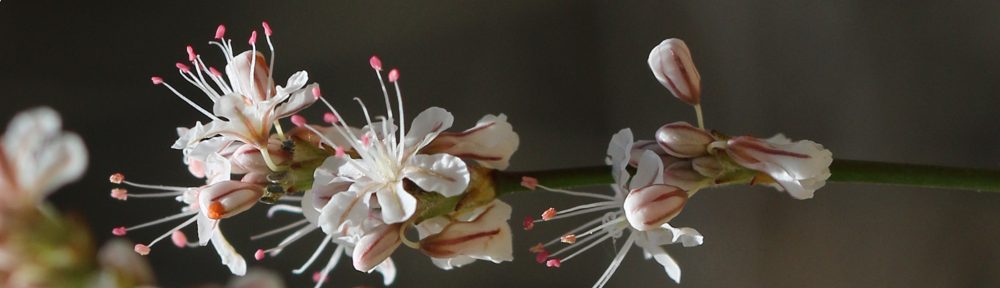
Plants spreading, not scapose, 2.5–4.5 dm tall, 1–2.5 dm across, glabrous, grayish; stems spreading, without persistent leaf bases, up to 1⁄4 height of plant, the caudex stems absent, the aerial flowering stems erect, slender, solid, not fistulose, 0.5–2 dm long, glabrous, pubescent among leaves; leaves basal, 1 per node, the petioles 1– 2.5 cm long, tomentose, the blades ovate to round, 1.2–2 (2.5) cm long, 1–1.7 (2) cm wide, tomentose on both surfaces, the margins plane; inflorescences cymose, 12–25 cm long, 10–20 cm wide, the branches dichotomous, glabrous, the bracts 3, scalelike, triangular, 1–3 mm long; peduncles absent; involucres (1) 2–5 per cluster, turbinate, 2.5–4 (4.5) mm long, 2–2.5 mm wide, glabrous, the teeth 5, erect, 0.4–0.8 mm long; flowers 2.5–3 mm long, the perianth white, glabrous, the hypanthium 1/5 length of perianth, the tepals monomorphic, obovate, the stamens exserted, 2.5–3.5 mm long, the filaments pilose proximally; achenes light brown to brown, 2.5–3 mm long, glabrous. Continue reading
Author Archives: xochipelli2012
Eriogonum microthecum var. microthecum
Plants shrubs, (2.5) 3–5 dm tall, 3–7 dm across; stems lacking a caudex, the aerial flowering stems 0.3–0.7 dm long, floccose or glabrous; leaf blades oblanceolate to elliptic, (0.8) 1–2 (2.7) cm long, (0.3) 0.4–0.9 (1.2) cm wide, densely white-tomentose abaxially, floccose or glabrous adaxially, the margins not revolute; inflorescences 3–10 cm long, the branches floccose or glabrous; involucres 2.5–3 mm long, floccose or glabrous; flowers 2–2.5 mm long, the perianth yellow; achenes 2–2.5 mm long.
Flowering Jul-Sep. Gravelly to rocky slopes, saltbush and sagebrush communities, juniper and conifer woodlands; 600–1100 m; Baker, Crook, Grant, Harney, Sherman, Wasco, and Wheeler cos. in Oregon with scattered populations in Washington Co., Idaho.
Continue reading
Eriogonum umbellatum var. ellipticum
Plants herbs, often rather compact mats, 1–3.5 dm tall, 2–5 dm across; aerial flowering stems erect, 0.7–2 (3) dm long, thinly floccose or glabrous, without one or more foliaceous bracts about midlength; leaves in loose rosettes, the blades usually elliptic, 1.5–3 (4) cm long, 1–1.5 cm wide, tomentose abaxially, usually glabrous adaxially, the margins plane; inflorescences compound-umbellate, branched 2–4 times, the branches thinly floccose or glabrous, without a whorl of bracts about midlength; involucral tubes 2–4 mm long, the lobes 2–4 mm long; flowers 6–8 mm long, the perianth bright yellow.
Eriogonum sphaerocephalum var. sphaerocephalum
Plants subshrubs, spreading to erect, infrequently polygamodioecious, 0.5–4 dm tall, 3–5 (6) dm across, floccose or glabrous; stems with caudex spreading, the aerial flowering stems erect, slender, solid, not fistulose, arising at nodes of caudex branches and at distal nodes of short, non-flowering aerial branches, (0.3) 0.5–1 dm long, thinly floccose or glabrous, with a whorl of 4–8 foliaceous bracts about midlength or proximally, linear-oblanceolate to oblanceolate, 1–2 cm long, 0.1–0.4 cm wide; leaves in loose to congested basal rosettes, the petioles 0.05–0.3 cm long, floccose or glabrous, the blades linear-oblanceolate, narrowly oblanceolate, or narrowly spatulate, 1–3 (4) cm long, (0.1) 0.3–0.6 (1) cm wide, lanate or tomentose to floccose or glabrous, the margins entire, plane or revolute; inflorescences capitate, compound-umbellate, or umbellate, 1–2 cm wide or 1–5 cm long and wide, the branches thinly floccose or glabrous, the bracts absent immediately below involucre; involucres 1 per node, turbinate-campanulate to campanulate, 3–4 mm long, 2.5–4.5 mm wide, the teeth 6–10, lobelike, slightly reflexed, 1.5–3 (5) mm long; flowers (5) 6–9 mm long, including a 1–2 mm long stipelike base, the perianth pale to bright yellow or cream to ochroleucous, villous abaxially, the tepals monomorphic, obovate to oblong-ovate, the stamens exserted, 4–6 mm long, the filaments pilose proximally; achenes light brown, 3–4 mm long, glabrous except for sparsely pubescent beak.
Eriogonum watsonii
Plants herbs, spreading, annual, (0.5) 1–4 dm tall, glabrous, glaucous, greenish to grayish; stems with caudex absent, the aerial flowering stems erect, solid, not fistulose, 0.4–0.8 dm long, glabrous; leaves basal, the petioles 1–3 cm long, mostly floccose, the blades subcordate to orbiculate, (0.5) 1–2.5 cm long and wide, densely white-tomentose abaxially, less so to subglabrous and grayish to greenish adaxially, the margins plane; inflorescences cymose, open, spreading, (5) 10–20 cm long, 5–20 cm wide, the branches glabrous, glaucous, the bracts 3, scalelike, 1–2 mm long, 0.5–1 mm wide; peduncles deflexed (Great Basin phase) or curving and ascending upward (Snake River phase), straight or slightly curved, slender, 0.3–1.5 cm long, glabrous; involucres narrowly turbinate, (1.5) 2–3 mm long, 0.5–1.5 mm wide, glabrous, the teeth 5, erect, 0.4–0.8 mm long; flowers 2–2.5 mm long, the perianth white to pink with greenish to reddish midribs, becoming pinkish to reddish, glabrous, the tepals dimorphic, those of outer whorl oblong or obovate, those of inner whorl ovate, the stamens included, 1.5–2 mm long, the filaments glabrous; achenes brown, trigonous, 1.5–2 mm long, glabrous. 2n = 40.
Eriogonum strictum var. proliferum
Plants herbs, erect, loosely to densely matted, not scapose, 1–5 dm tall, 1–10 dm across, tomentose or glabrous; stems spreading to erect, with or without persistent leaf bases, up to 1⁄4 height of plant, the caudex stems absent or spreading to matted, the aerial flowering stems erect to spreading, slender, solid, not fistulose, 1–3 dm long, tomentose or glabrous; leaves basal, 1 per node, the petioles rarely twisted or curled, 1–6 cm long, mostly tomentose, the blades elliptic to ovate, 0.5–2.5 (4) cm long, (0.3) 0.5–1.5 cm wide, lanate, tomentose to floccose on both surfaces, sometimes sparsely tomentose to floccose and greenish or floccose to subglabrous or glabrous adaxially, the margins plane; inflorescences umbellate-cymose to cymose, 1–20 cm long, 3–25 cm wide, the branches dichotomous, tomentose to floccose or less often glabrous, the bracts 3, scalelike, triangular, 1–3 mm long; peduncles absent; involucres 1 per node, rarely 2–5 per cluster, narrowly turbinate to turbinate-campanulate, 4–6 mm long, 1.5–5 mm wide, tomentose or glabrous, the teeth 5, erect, 0.5–1.3 mm long; flowers 3–5 (6) mm long, the perianth yellow or white to rose or purple, glabrous, the hypanthium only at base of perianth, the tepals dimorphic, those of outer whorl elliptic to nearly orbiculate, 2–3 mm long and wide, those of inner whorl oblanceolate to oblong, 3–4 mm long, 1–2 mm wide, the stamens included to slightly exserted, 2–5 mm long, the filaments pilose proximally; achenes light brown to brown, 3– 3.5 mm long, glabrous.
Eriogonum novonudum
Plants herbs, erect, not scapose, (3) 3.5–9 dm tall, 0.5–1 dm across; stems spreading, without persistent leaf bases, up to 1/5 height of plant, the caudex stems absent, the aerial flowering stems erect, slender, solid, not fistulose, 1.5–3.5 (4) dm long, glabrous; leaves basal, 1 per node, the petioles (1) 2–4 (6) cm long, tomentose, the blades spatulate to narrowly obovate, 1–3 (4) cm long, 0.3–0.8 (1.3) cm wide, densely white-tomentose on both surfaces, the margins plane; inflorescences elongate cymose-umbellate, 8–45 (50) cm long, 5–10 cm wide, the branches dichotomous, glabrous, the bracts 3–5, scalelike, triangular, 1–2 mm long; peduncles absent or 0.1–0.25 cm long; involucres 2–5 per cluster, turbinate, 3–5 mm long, 2–3 mm wide, rigid, glabrous, the teeth 6–8, erect, 0.5–1 mm long; flowers (1.5) 2.5–3.5 mm long, the perianth dull greenish-white to pale yellow, glabrous, the hypanthium only at base of perianth, the tepals monomorphic, lanceolate to oblong, the stamens exserted, 3–5 mm long, the filaments pilose proximally; achenes light brown, 2.5–3 mm long, glabrous. Continue reading
Eriogonum microthecum var. phoeniceum
Plants subshrubs, 0.5–1.5 dm tall, 1–3 dm across; stems lacking a caudex or caudex sometimes spreading, the aerial flowering stems 0.2–0.6 dm long, tomentose to floccose; leaf blades elliptic, 0.3–0.7 (0.8) cm long, 0.1– 0.4 cm wide, densely reddish-brown-tomentose abaxially, tomentose to floccose adaxially, the margins not revolute; inflorescences 2–6 cm long, the branches tomentose to floccose; involucres 2.5–3.5 mm long, floccose to subglabrous; flowers (1.5) 2–3.5 mm long, the perianth whitish-red to pink, rose, or orange; achenes 2.5–3 mm long.
Eriogonum brevicaule var. desertorum
Plants pulvinate and cespitose, 0.5–1.2 dm tall, 0.7–4 dm across; aerial flowering stems erect, scapelike, (0.2) 0.4–1 dm long, tomentose or floccose; leaf blades oblanceolate to elliptic or, rarely, ovate, 0.4–2 (2.5) cm long, 0.2–1 cm wide, densely greenish- or grayish-white-tomentose on both surfaces or densely greenish-white tomentose abaxially, the margins plane; inflorescences capitate, 0.7–1.5 cm long, the branches absent; flowers 2–3.5 mm long, the perianth yellow, glabrous.
Eriogonum kingii
Plants herbs, matted, scapose, 0.2–1.5 dm tall, 0.5–4 dm across; stems matted, with persistent leaf bases, up to 1/5 height of plant, the caudex stems matted, the aerial flowering stems scapelike, erect, slender, solid, not fistulose, 0.2–1 (1.5) dm long, tomentose or floccose to subglabrous or even glabrous; leaves basal, fasciculate in terminal tufts, the petioles (0.2) 0.4–2 (3) cm long, tomentose, the blades oblanceolate to spatulate or elliptic, 0.5–1.5 (2) cm long, (0.2) 0.3–0.8 (1) cm wide, densely white- or greenish-tomentose on both surfaces, the margins plane; inflorescences capitate, 0.8–1.7 (2) cm long, the branches absent, the bracts 3–5, linear to narrowly scalelike, triangular, 1.5–3 mm long; peduncles absent; involucres 3–5 per cluster, turbinate- campanulate to campanulate, 2.5–3.5 mm long, 2.5–4 mm wide, membranous, sparsely pubescent or rarely sparsely glandular abaxially, the teeth 5–6, erect to spreading, 0.7–1.8 (2) mm long; flowers (2.5) 3–3.5 mm long, the perianth greenish-yellow or pale yellow, rarely yellow, glabrous or sparsely glandular abaxially, the hypanthium 1⁄4-1⁄2 length of perianth, the tepals monomorphic, spatulate to obovate, the stamens exserted, 2–3.5 mm long, the filaments glabrous or sparsely pilose proximally; achenes light brown, 2.5–3 mm long, glabrous except for slightly papillate beak in some. 2n = 40.
 Eriogoneae
You must be logged in to post a comment.