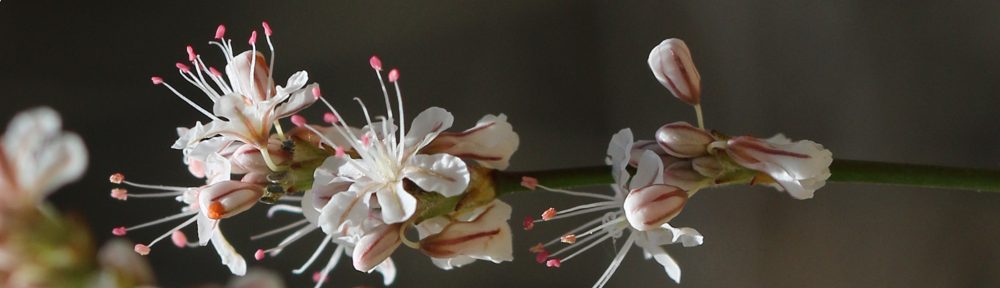
Plants herbs, matted, scapose, 0.3–1 dm tall, 1–3 dm across; stems spreading, with persistent leaf bases, up to 1/5 height of plant, the caudex stems matted, the aerial flowering stems weakly erect, slender, solid, not fistulose, 0.2–0.6 (0.8) dm long, glabrous; leaves basal, fasciculate in terminal tufts, the petioles 0.2–0.5 cm long, tomentose, the blades oblanceolate to spatulate or elliptic to ovate, 0.3–1 (1.4) cm long, 0.15–0.4 (0.6) cm wide, densely white-tomentose on both surfaces, the margins plane; inflorescences capitate, 0.8–1.2 cm wide, the branches absent, the bracts 3–6, triangular, scalelike, 1–3 (4) mm long; peduncles absent; involucres 4–7 per cluster, campanulate, 2–3 mm long and wide, weakly rigid, glabrous or sparsely floccose, the teeth 5– 6, erect, 0.8–1.4 mm long; flowers 2–3 mm long, the perianth bright yellow, glabrous, the hypanthium 1⁄4–1⁄3 length of perianth, the tepals monomorphic, oblong to oblong-obovate, the stamens exserted, 2.5–3.5 mm long, the filaments pilose proximally; achenes light brown, 2–3 mm long, glabrous. 2n = 40.
Author Archives: xochipelli2012
Eriogonum robustum
Plants herbs, erect, matted, 0.5–3 dm tall, 1–2 dm across, tomentose to floccose; stems with caudex absent, the aerial flowering stems erect or nearly so, stout, solid, not fistulose, usually arising directly from a taproot, 0.5– 1.2 (1.6) dm long, tomentose to floccose; leaves basal, in well-defined rosettes, the petioles 1–4 (5.5) cm long, tomentose to floccose, the blades ovate to obovate, 2.5–4 (5) cm long, 1.6–2.5 (3.5) cm wide, densely white- to grayish- or reddish-tomentose abaxially, less so to floccose or glabrous and greenish adaxially, the margins entire, plane; inflorescences biumbellate, 5–10 cm long and wide, the branches tomentose to floccose, the bracts 3–5 at proximal node, foliaceous, 1.5–2.5 (3.5) cm long, 0.3–0,8 (1) cm wide, sometimes absent immediately below involucre; involucres 1 per node, campanulate, 8–11 (13) mm long, 8–12 mm wide, thinly tomentose to lanate, the teeth 6–10, usually lobelike, mostly reflexed, 2–6 mm long; flowers 7–9 mm long, including a 0.1–0.4 mm long stipelike base, the perianth creamy yellow to pale yellowish, glabrous, the tepals monomorphic, oblong-obovate, the stamens exserted, 7–9 mm long, the filaments pilose proximally; achenes light brown to brown, 6–8 mm long, glabrous.
Eriogonum elatum var. elatum
Plants herbs, erect, not scapose, 4–8 (15) dm tall, 1–4 dm across, glabrous or villous; stems erect, without persistent leaf bases, up to 1/5 height of plant, the caudex stems absent, the aerial flowering stems erect, slender to stout, solid or hollow, infrequently fistulose, 1.5–4 (8) dm long, glabrous; leaves basal, the petioles 5–25 cm long, villous, the blades lanceolate to lance-ovate, 4–15 (25) cm long, 1.5–6 cm wide, loosely villous and green on both surfaces or infrequently thinly tomentose abaxially and glabrate adaxially, the margins plane; inflorescences cymose, 15–50 cm long, 10–30 cm wide, the branches glabrous or villous, the bracts 3, semi-foliaceous, linear, and 5–30 mm long, 2–5 mm wide proximally, scalelike, triangular, and 1–4 mm long distally; peduncles absent or slender, erect, 0.5–4 cm long, glabrous or tomentose; involucres 1 per node or 2–5 per cluster, turbinate, (2.5) 3–4 mm long, 2.5–3 mm wide, glabrous or slightly tomentose, the teeth 5, erect, 0.4–0.9 mm long; flowers 2.5–4 mm long, glabrous, the perianth white, pubescent abaxially, the hypanthium 1⁄4 length of perianth, the tepals monomorphic, obovate, the stamens exserted, 2.5–4 mm long, the filaments pilose proximally; achenes light brown, 3.5–4 mm long, glabrous.

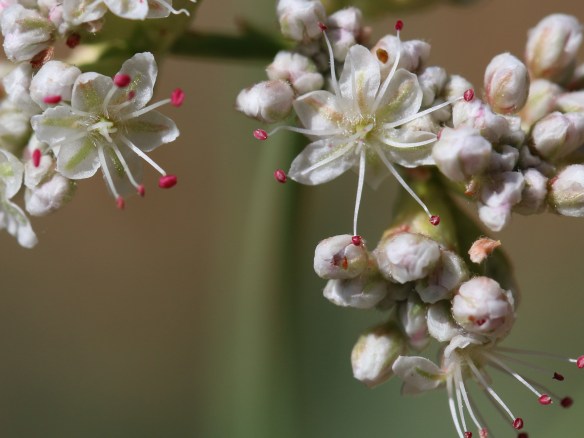
Flowering May-Oct. Sandy to gravelly slopes and flats, mixed grassland and sagebrush communities, pinyon, juniper, and conifer woodlands; 60–3000 m.





Eriogonum spergulinum var. reddingianum
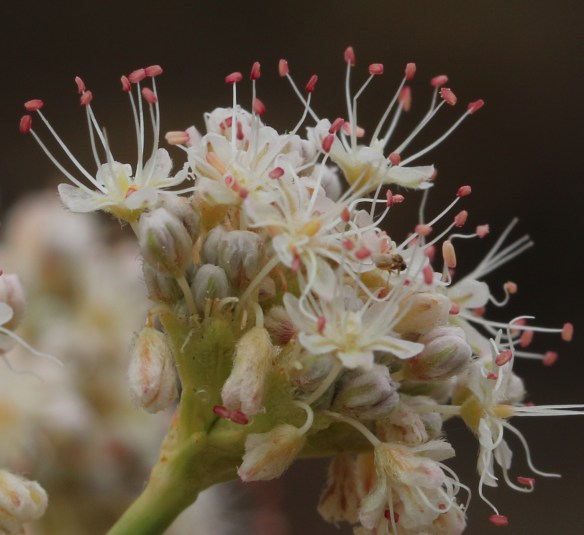
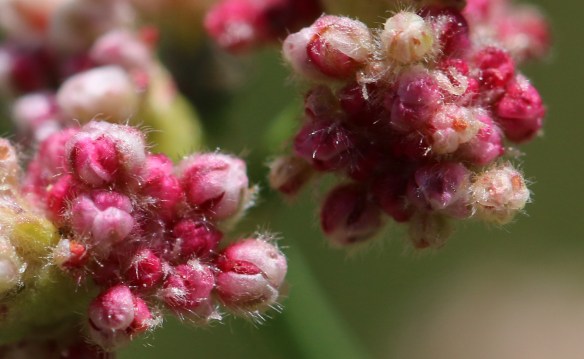
Plants erect, 0.8–4 dm tall, glabrous or glandular and short-hispid, greenish, grayish, or reddish; stems with caudex absent, the aerial flowering stems prostrate to erect, solid, not fistulose, 0.1–0.5 dm long, glabrous or glandular and short-hispid; leaves basal and cauline; basal: petiole 0.05–0.3 cm long, hispid, the blade linear, (0.3) 1–3 (4) cm long, 0.05–0.3 cm wide, short-hispid, the margins plane or revolute, ciliate; cauline: sessile, the blade linear, 0.3–2.5 cm long, 0.05–0.3 cm wide, similar to basal blade; inflorescences cymose, open to diffuse, 4–25 cm long, 5–35 cm wide, the branches sparsely hispid to puberulent, internodes glandular, the bracts 3–6, semi-foliaceous, 2–10 mm long, 0.5–2 mm wide; peduncles erect, straight, filiform, 0.4–1.5 cm long, glabrous; involucres turbinate, 0.5–1 mm long, 0.4–0.8 mm wide, glabrous, the teeth 4, erect, 0.2–0.4 mm long; flowers 1.5–2.5 mm long, the perianth white with greenish to reddish midribs, becoming pinkish to rose, glabrous or sparsely pubescent, the tepals monomorphic, oblong, the stamens included, 0.5–2 mm long, the filaments usually glabrous; achenes brown to blackish, lenticular, 1.5–2.3 mm long, glabrous.
Flowering Jun-Sep. Sandy to gravelly, often granitic or pumice flats and slopes, sagebrush communities, oak, montane, and subalpine conifer woodlands; 1300–3400 m;
Eriogonum baileyi var. baileyi
Plants herbs, erect to spreading, 1–4 (5) dm tall, glabrous, grayish; aerial flowering stems erect, 0.5–1 dm long, glabrous; leaves basal, the petioles 0.5–3 cm long, tomentose, the blades suborbiculate, 0.5–2 cm long and wide, densely white-tomentose abaxially, mostly tomentose and grayish to greenish adaxially; inflorescences cymose, infrequently distally uniparous due to suppression of secondary branches, open to diffuse, 5–35 (45) cm long, 5–35 (4) cm wide, the branches glabrous, the bracts 0.5–3 mm long, 1–3 mm wide; peduncles absent; involucres somewhat appressed to branches, turbinate, 1–1.5 mm long, 0.5–1 mm wide, glabrous or tomentose, the teeth 5, erect, 0.2–0.3 mm long; flowers 1.5–2 mm long, the perianth white to rose, minutely glandular, rarely glabrous, the tepals monomorphic, oblong to oblong- obovate, somewhat constricted near middle and flaring adaxially, the stamens included, 1–1.5 mm long, the filaments pilose proximally; achenes brown, trigonous, 1–1.5 mm long. Flowering May-Oct. Sandy to gravelly washes, flats, and slopes, mixed grassland, saltbush, greasewood and sagebrush communities, pinyon-juniper, oak, or montane conifer woodlands; (100) 500–2900 m.
Eriogonum nidularium
Plants herbs, erect to slightly spreading, 0.5–1.5 (2) dm tall, floccose to tomentose, greenish to tawny; aerial flowering stems mostly erect, 0.05–0.3 dm long, floccose to tomentose; leaves basal, the petioles 1–3 (5) cm long, tomentose, the blades rounded to cordate, cm long, 1–2 (2.5) cm long and wide, densely white-tomentose abaxially, tomentose to floccose and occasionally greenish adaxially; inflorescences narrowly cymose, distally uniparous due to suppression of secondary branches, diffuse, 5–15 (20) cm long, 5–20 (30) cm wide, the branches inwardly curved distally, floccose to tomentose, the bracts 0.5–3 mm long, 1–3 mm wide; peduncles absent; involucres appressed to branches, cylindric-turbinate, 1–1.3 mm long, 0.5–0.7 mm wide, floccose, the teeth 5, erect, 0.1–0.2 mm long; flowers 1–3 (3.5) mm long, the perianth pale yellow or yellow, rarely creamy white, becoming red, glabrous, the tepals dimorphic, those of outer whorl broadly fan-shaped, those of inner whorl oblanceolate, the stamens included, 1–1.5 mm long, the filaments pilose proximally; achenes light brown, trigonous, 1–1.3 mm long.
Eriogonum ampullaceum
Plants herbs, erect, 1–3 dm tall, glabrous, yellowish-green to gray; aerial flowering stems erect, 0.2–1 dm long, glabrous; leaves basal, the petioles 0.5–4 cm long, tomentose, the blades orbiculate to subcordate, 0.5–2 (2.5) cm long and wide, white-tomentose abaxially, tomentose to floccose and grayish or greenish adaxially; inflorescences cymose, open, narrow, 5–25 cm long, 5–10 (15) cm wide, the branches glabrous, the bracts 0.5– 1.5 mm long, 1–2 mm wide; peduncles absent; involucres terminal at tips of slender branchlets at least proximally, not appressed to mm wide; peduncles absent; involucres terminal at tips of slender branchlets at least proximally, not appressed to branches, turbinate-campanulate, 1.5–2 mm long and wide, glabrous, the teeth 5, erect, 0.5–0.8 mm long; flowers 1–1.5 mm long, the perianth cream, reddish-green to reddish proximally, glabrous, the tepals monomorphic, obovate, the stamens exserted, 1–1.5 mm long, the filaments pilose proximally; achenes brown, lenticular, 1–1.3 mm long. Continue reading
Eriogonum nudum var. deductum
Plants 2–3 (5) dm tall; aerial flowering stems not fistulose, 0.5–1.5 dm long, glabrous; leaves basal, the blades 1–2 cm long, 0.3–0.8 (1) cm wide, tomentose abaxially, floccose or glabrous adaxially, the margins plane; inflorescences cymose, 5–15 cm long, 5–15 (20) cm wide, the branches glabrous; involucres 1 (2) per cluster, 2.5–3.5 mm long, glabrous or sparsely pubescent; flowers 2–3 mm long, the perianth white, glabrous. 2n = 40.
Eriogonum leptocladon var. ramosissimum
Plants shrubs, erect to spreading, not scapose, (2) 3–10 (12) dm tall, 5–15 (20) dm across, white-tomentose to floccose, or green and nearly glabrous; stems spreading, often without persistent leaf bases, up to 1⁄2 height of plant, the caudex stems absent or spreading in moving sand, the aerial flowering stems spreading, slender, solid, not fistulose, 0.3–1 dm long, white-tomentose, floccose to glabrate or glabrous; leaves cauline, 1 per node, the petioles 0.2–0.5 cm long, tomentose to floccose, the blades linear-lanceolate to linear-oblanceolate to narrowly oblong, or lanceolate to narrowly elliptic, 1.5–4 cm long, 0.2–0.8 (1.2) cm wide, densely white- tomentose abaxially, less so and greenish adaxially, the margins plane, infrequently revolute; inflorescences cymose, open, 5–40 cm long, 10–50 cm wide, the branches dichotomous proximally, often with involucres racemosely arranged proximally, tomentose to floccose or glabrate, occasionally glabrous, the bracts 3, scalelike, linear to triangular, 1–3 (6) mm long; peduncles absent; involucres 1 per node, turbinate to turbinate-campanulate, 1.5–3 mm long, 1–2 mm wide, tomentose to floccose or glabrous, the teeth 5, erect, 0.4–0.7 mm long; flowers (2) 2.5–3.5 mm long, the perianth white or pale yellow to yellow, glabrous, the hypanthium 1⁄4-1⁄3 length of perianth, essentially monomorphic, oblong to broadly obovate, the stamens slightly exserted, 2–4 mm long, the filaments sparsely pilose proximally; achenes light brown, 2.5–3.5 mm long, glabrous except for minutely papillate beaks. Continue reading
Eriogonum leptocladon var. leptocladon
Plants shrubs, erect to spreading, not scapose, (2) 3–10 (12) dm tall, 5–15 (20) dm across, white-tomentose to floccose, or green and nearly glabrous; stems spreading, often without persistent leaf bases, up to 1⁄2 height of plant, the caudex stems absent or spreading in moving sand, the aerial flowering stems spreading, slender, solid, not fistulose, 0.3–1 dm long, white-tomentose, floccose to glabrate or glabrous; leaves cauline, 1 per node, the petioles 0.2–0.5 cm long, tomentose to floccose, the blades linear-lanceolate to linear-oblanceolate to narrowly oblong, or lanceolate to narrowly elliptic, 1.5–4 cm long, 0.2–0.8 (1.2) cm wide, densely white- tomentose abaxially, less so and greenish adaxially, the margins plane, infrequently revolute; inflorescences cymose, open, 5–40 cm long, 10–50 cm wide, the branches dichotomous proximally, often with involucres racemosely arranged proximally, tomentose to floccose or glabrate, occasionally glabrous, the bracts 3, scalelike, linear to triangular, 1–3 (6) mm long; peduncles absent; involucres 1 per node, turbinate to turbinate-campanulate, 1.5–3 mm long, 1–2 mm wide, tomentose to floccose or glabrous, the teeth 5, erect, 0.4–0.7 mm long; flowers (2) 2.5–3.5 mm long, the perianth white or pale yellow to yellow, glabrous, the hypanthium 1⁄4-1⁄3 length of perianth, essentially monomorphic, oblong to broadly obovate, the stamens slightly exserted, 2–4 mm long, the filaments sparsely pilose proximally; achenes light brown, 2.5–3.5 mm long, glabrous except for minutely papillate beaks. Continue reading
 Eriogoneae
You must be logged in to post a comment.