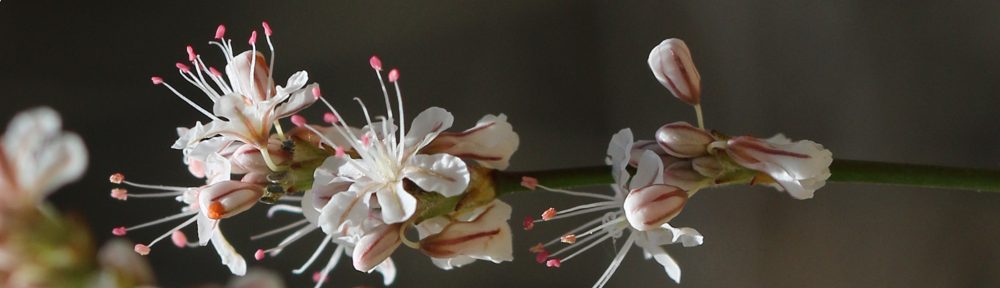
Plants herbs, erect, annual, (1.5) 2–4 dm tall, glabrous, greenish to grayish; stems with caudex absent, the aerial flowering stems erect, solid, not fistulose, 0.3–2 dm long, glabrous; leaves basal, the petioles 1–3 (5) cm long, floccose, the blades cordate to orbiculate, (0.5) 1–3 (5.5) cm long, (0.5) 1–3 (5) cm wide, densely white- tomentose abaxially, less so to subglabrous and grayish to greenish adaxially, the margins entire; inflorescences cymose, diffuse, of many horizontal tiers of flat-topped branches, 10–35 cm long, 5–35 cm wide, the branches glabrous, the bracts 3, scalelike, 1–3 mm long, 0.5–1.5 mm wide; peduncles absent; involucres deflexed, narrowly campanulate, 1–1.5 mm long, 1.5–2 mm wide, glabrous, the teeth 5, erect, 0.4– 0.7 mm long; flowers 1.3–1.5 mm long, the perianth white with greenish midribs, becoming reddish, glabrous, the tepals dimorphic, those of outer whorl narrowly oval to cordate, those of inner whorl narrowly lanceolate, the stamens included, 1–1.3 mm long, the filaments glabrous; achenes dark brown, lenticular, 1.3–1.5 mm long, glabrous. 2n = 40.
Author Archives: xochipelli2012
Eriogonum brachypodum
Eriogonum brachypodum, from the Greek “brachys”, short, and “podos”, foot, as to the short peduncles. Continue reading
Eriogonum umbellatum var. versicolor
Plants herbs, spreading to somewhat prostrate mats, 1–3 dm tall, 1–4 dm across; aerial flowering stems usually erect, 0.5–1.5 dm long, floccose, without one or more foliaceous bracts about mid-length; leaves mostly in loose rosettes, the blades usually elliptic, 0.5–1.5 cm long, 0.3–1 cm wide, thinly tomentose on both surfaces, sometimes nearly or quite glabrous and green or becoming reddish adaxially, the margins plane; inflorescences umbellate or compound-umbellate, the branches 0.5–1 dm long, without a whorl of bracts about mid-length, floccose; involucral tubes 2–3 mm long, the lobes 1–2 mm long; flowers 3–6 mm long, the perianth yellow, becoming reddish-brown to rose or pink, with large reddish spot on each midrib.
Eriogonum eremicola
Plants herbs, spreading, annual, 0.8–2.5 dm tall, glandular, greenish to reddish; stems with caudex absent, the aerial flowering stems erect, solid, not fistulose, 0.3–1 dm long, glandular; leaves basal, the petioles 1–3 cm long, floccose; leaf blade rounded, 1–2.5 cm long and wide, densely white-tomentose abaxially, floccose or glabrous and greenish adaxially, the margins plane; inflorescences cymose, open to somewhat diffuse, 5–20 cm long and wide, the branches glandular, the bracts 3, scalelike, 1–2 mm long, 0.5–1.5 mm wide; peduncles absent or deflexed, straight, slender, (0.1) 0.5–1 cm long, glandular; involucres turbinate-campanulate, 1.8–2 mm long, 1–1.5 mm wide, glandular, the teeth 5, erect, 0.5–0.8 (1) mm long; flowers 2–2.5 mm long, the perianth white with red midribs, becoming red, glabrous, the tepals monomorphic, oblong-ovate, the stamens exserted, 2–2.5 mm long, the filaments glabrous; achenes brown, trigonous, 2–2.5 mm long, glabrous.
Eriogonum microthecum var. panamintense
The flowers were taken at 2486 m. of altitude, in Death Valley, above Thorndike Camp, Wild Rose Canyon, where I went with my 27 foot RV. Yes I did. Continue reading
Eriogonum deflexum var. deflexum
Plants (0.5) 1–5 (20) dm tall; flowering stems not fistulose; inflorescences flat-topped, spreading, hemispheric, rarely narrowly erect and strict with whiplike branches; peduncles absent or deflexed, rarely some ± erect distally, (0.1) 0.2–0.5 cm long; involucres turbinate, 1.5–2.5 mm long; flowers 1–2 mm long, the outer tepals cordate to ovate. 2n = 40. Continue reading
Eriogonum brachyanthum
Plants herbs, spreading, (0.5) 1–3 dm tall, glabrous, greenish; aerial flowering stems erect, 0.3–0.8 dm long, glabrous; leaves basal, the petioles 0.5–3 cm long, tomentose, the blades ovate to rounded, 0.5–2 cm long and wide, densely white-tomentose on both surfaces, rarely glabrate and grayish or greenish adaxially; inflorescences cymose, occasionally distally uniparous due to suppression of secondary branches, usually diffuse, 5–25 cm long, 5–30 cm wide, the branches glabrous, the bracts 0.5–2 mm long and wide; peduncles absent; involucres somewhat appressed to branches, turbinate, 1–1.2 mm long, 0.4–0.6 mm wide, glabrous, the teeth 5, erect, 0.2–0.3 mm long; flowers 0.6–0.8 (1) mm long, the perianth yellow or pale yellowish, rarely whitish, glabrous, the tepals slightly dimorphic, those of outer whorl oblong to oblong-obovate, those of inner whorl narrowly oblong, the stamens included, 0.5–0.8 mm long, the filaments pilose proximally; achenes dark brown, trigonous, 0.8–1 mm long. Continue reading
Key to the subgenera
Eriogonum Michaux. Wild buckwheat [Greek erion, wool, and gony, knee, alluding to the hairy nodes of the species first described, E. tomentosum]. This key to the subgenera has been devised by James L. Reveal.
Eriogonum wrightii var. subscaposum
Plants herbs, loosely matted, 0.5–2.5 (3) dm tall, 1–3 (5) dm across; aerial flowering stems tomentose or glabrous; leaves with petiole bases not forming distinct ring around stem, the blades oblanceolate to elliptic, 0.5–1 (1.2) cm long, 0.2–0.4 (0.5) cm wide; inflorescences virgate or cymose, the branches dichotomous, mostly slender; involucres 1.5–4 mm long; flowers 2–3 mm long, the perianth white to pink; achenes 2–2.5 mm long. 2n = 34.
Eriogonum umbellatum var. chlorothamnus
Plants subshrubs or shrubs, erect to rounded, (4) 5–10 (12) dm tall, 5–12 dm across; aerial flowering stems erect, 1–2.5 dm long, glabrous, without one or more foliaceous bracts about mid-length; leaves in rather loose rosettes, the blades oblanceolate to narrowly elliptic, 0.5–2 cm long, 0.3–1 cm wide, glabrous on both surfaces, the margins plane; inflorescences compound-umbellate, branched 2–5 times, the branches glabrous, without a whorl of bracts about mid-length; involucral tubes 2–2.5 mm long, the lobes 1–1.5 mm long; flowers 3–6 mm long, the perianth bright yellow.
 Eriogoneae
You must be logged in to post a comment.